Nick Gillespie, reason.com/blog; via LH on Facebook
America has never been a "white" country. Economic and cultural nativism is on the rise - and the most un-American idea of all.
Georgetown Book ShopCan you guess who the victims were of the largest mass-lynching in American history and where it took place? Most people would, I think, guess blacks first, then maybe Mexicans or Native Americans. And we'd assume it was somewhere in the old Confederate states. Writing in the Boston Globe, Jeff Jacoby notes that the 18 men and boys killed on October 24, 1871 were chosen dragged out of their houses and beaten and hanged because they were Chinese. The locale wasn't Alabama or Mississippi, either. It was Los Angeles, California.
They were Chinese, and they were murdered by a mob, nearly 500 strong, that included some of the city's leading citizens.
"Their first victim was an elderly, inoffensive Chinaman, whom they seized and dragged headlong through the streets, beating and abusing him at every step," the Los Angeles Daily Mirror later recounted. At the corner of Temple and New High streets, the lynch party tied a noose around the old man's neck and hauled him up. "The rope broke and the unfortunate wretch, innocent of any wrong, asked for mercy from his cruel tormentors. This was denied with jeers, and he was again hung up; this time successfully."
As readers of Reason know, the first mass exclusions on the basis of country of origin (then as now a proxy for protean categories of race) covered the Chinese in a law titled with unabashed descriptiveness: The Chinese Exclusion Act of 1882. (Read Erika Lee's recent history The Making of Asian America for more.)
Jacoby notes that Chinese now comprise the single-largest group emigrating to the United States:
In 2013, according to the Census Bureau, China was the country of origin for 147,000 US immigrants, compared to just 125,000 who came from Mexico. Over the previous 10 years, immigration from China and other Asian countries had been rising, while immigration from Mexico decreased. Since at least 2009, reported demographer Eric Jensen, more immigrants to America have been Asian than Hispanic. By 2013, the disparity was unmistakable: Asians accounted for 40.2 percent of the total immigration flow. Hispanics made up only 25.5 percent.
Last week, The Wall Street Journal crunched even more recent numbers. "In 2014, there were 31 states where more immigrants arrived from China than from Mexico. . . . Even in California, a top destination for Latinos, Chinese immigrants outnumbered Mexican immigrants." (The data include all immigrants, legal and illegal.)
Wikimedia, public domainIf Mexicans are the enemy within—all this talk of deporting millions of undocumented immigrants is mostly aimed at them—China has mostly replaced Russia or Japan as our major enemy without. Hillary Clinton, Bernie Sanders, virtually all of the failed GOP candidates for president, and especially Donald Trump mince no words in saying they will hold China accountable for flexing its regional military might, "manipulating" its currency (something all national central banks do simply by existing), and especially "stealing" American jobs. And of course, Chinese immigrants in America threaten "us" in a way that is less like low-skilled Mexicans and more like the fears stoked by Jews back in the early 20th century: Chinese kids are so super-smart, especially in math and engineering, right, that they aren't taking manual-labor gigs away from low-income, low-skilled natives? They're taking away all the slots at the University of California system and maybe even the Ivy League! They're not human, they work too hard!
Jacoby closes his piece with a trenchant observation about how "we" (real Americans, who can trace at least two generations in the U.S. of A.!, but not inlcuding blacks) always eventually do the right thing after exhausting all other options:
We look back today at the demonization of Chinese immigrants in the 1870s and 1880s and are aghast that so many Americans could have spouted such ludicrous, ugly stuff. We have come a long way from the Chinese Exclusion Act to today's robust Asian immigration flows. A generation or two hence, Americans will look back at the harsh and unworthy immigration politics of our time, and be equally aghast that Mexicans were so reviled, and US citizens so willing to be deluded.
He's right about that. We eventually accept most ethnicities as A-OK (again, except for blacks and maybe American Indians). When my maternal grandparents (and as many of their relatives who could scrape together the money for a steerage-class ticket) showed up in America in the 1910s from god-forsaken southern Italy (a very distinct place than practically Austrian/French/Swiss and hence semi-legitimate northern Italy), they weren't white. No, they and their dusky skin, short bodies, and (obvious!) lack of intellectual capacity and impulse control were a big part of The Passing of the Great Race, or the pollution of the Nordic blood that defined true Americans, in Madison Grant's influential, idiotic thought. One of the great achievements of the 20th century (for my family, at least) was that my parents, born of Italian parents on side and Irish immigrants on the other, emerged as fully white and American within 40 or 50 years of being born. It only took suffering through the Depression, really, and supplying infantry members in World War II and Korea. Certainly, by the early 1970s (when the foreign-born population was at a historic low), nobody was questioning whether micks and wops didn't belong; the same went for Jews, whether they came originally from Germany, Poland, Russia, or wherever. In an era of rising crime rates, street violence, and economic empowerment of often-ethnic sports and movie stars who weren't interested in taking a back seat, traditional white America had bigger problems and needed more troops to fight off the onslaught of Puerto Ricans and Dominicans in the Northeast, Mexicans in the Southwest, and blacks and American Indians everywhere (the numbers of these latter two groups weren't increasing, but they were increasingly restive). Japanese went from being interned during World War II to being honorary whites and the same was kinda-sorta true for Chinese, Koreans, and Vietnamese refugees (once they learned unaccented English, at least).
What counts as "white" has always been fluid and fraudulent, but it often (always?) comes at the expense of some new out-group. Hell, in the days after the 9/11 attacks, even blacks were "white" for a while, because we were all united against Arabs or Muslims (and maybe Sikhs, because they seemed like kind of the same thing and people still aren't making clear distinctions between nationalities and religion). Jacoby is sanguine that anti-Chinese animus is deeply buried in the past, like coolies in a mountain landslide during the building of the transcontinental railroad. I'm not so sure, especially if economic growth continues to snail-pace along at less than 2 percent a year. That sort of anemic expansion—a product of all sorts of things, including out-of-control government spending, ever-increasing regulatory dicta, and forcibly misallocated dollars into everything from defense spending to insurance premiums to ineffective safey rules—makes us all crabs in a pot that seems to be getting smaller all the time. The water gets hotter and well, you start fighting like nobody's business to kick out everyone you can. If Chinese immgrants keep coming over in relatively large numbers, Chinese Americans keep doing well here, and China continues coming into focus as our major economic and military adversary on the world stage, we could easily see a resurgence of the worst sort of populist racism and discrimination.
In an exchange related to his column, the Globe's Jacoby tweeted this out:
I think that's just about exactly right. Certainly, it helps explain that amazing and largely unremarked upon fact of assimilation and acculturation that my parents, especially on my mother's side, as Italians were more "foreign" than Irish, managed in less than a lifetime. My mother's parents never spoke English their entire lives, yet before they died, the Italian-American immigrant experience, as cartoonishly but powerfully expressed in The Godfather novel and movies, had become the American experience. When my folks got married in 1950, it was considered a species of mixed marriage (made possible only by the fact that they were both Catholic, itself a centuries-old marker for being less-than-fully "American"). The idea of America as a place where anyone from anywhere can come and express their potential through radical economic, cultural, and political freedom is what's exceptional about this country. At its best, America is always something new and constantly changing, becoming, one hopes, ever-more inclusive and expansive. There's always room for more of everything in a country that has barely gotten started.
Nick Gillespie is the editor in chief of Reason.com and Reason TV and the co-author, with Matt Welch, of The Declaration of Independents: How Libertarian Politics Can Fix What's Wrong With America (2011/2012). He is also a columnist for The Daily Beast.
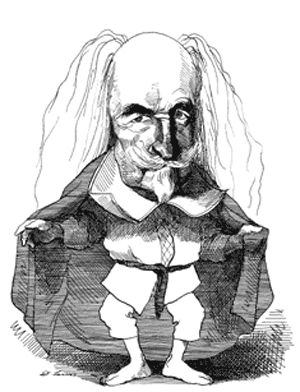
It is fascinating to learn about the concrete historical circumstances under which great philosophical works—works that have become timeless classics—were produced, and about the relation to their own times of the extraordinary individuals who produced them. For those with limited firsthand knowledge of the works this biographical approach can serve as an accessible introduction or reintroduction to the thought of some of the most important creators of our intellectual world. Anthony Gottlieb, a former executive editor of The Economist who is not a philosopher but a philosophical fellow traveler, is writing just such a history of the entire course of Western philosophy. The first volume,The Dream of Reason (2000),* took the story from ancient Greece to the Renaissance. The second volume,The Dream of Enlightenment, ends in the eighteenth century; a third volume will take us from Kant to the present day.
Gottlieb concentrates most of his discussion on six philosophers of the seventeenth and eighteenth centuries whose stature and influence are especially great—Descartes, Hobbes, Spinoza, Locke, Leibniz, and Hume—along with shorter treatments of Bayle, Voltaire, and Rousseau, and brief comments on many other figures. Here is what he says at the outset:
It is because they still have something to say to us that we can easily get these philosophers wrong. It is tempting to think that they speak our language and live in our world. But to understand them properly, we must step back into their shoes. That is what this book tries to do.
Gottlieb exaggerates the intellectual distance of these figures from us: it isn’t that they speak our language, but that we speak their language, because our world has been significantly formed by them. And he does not always succeed in stepping back into their shoes, which in the case of a great philosopher means understanding his thoughts from the inside, as well as in relation to his historical milieu. Nevertheless Gottlieb’s biographical narrative is vivid and often illuminating. Most important, he emphasizes throughout that these men lived in a historical period dominated by dramatic developments and conflicts in three areas—science, religion, and politics—and that their thoughts and writings were dominated by the need to respond to those developments, and to understand the relations among them.
First, there was the scientific revolution, which introduced a new way of understanding the physical world through universal laws, mathematically formulated, that govern everything that happens in space and time. Although knowledge of those laws is based on observation and experiment, the reality they describe is not directly available to human perception, but can be known only by theoretical inference. Two of Gottlieb’s thinkers, Descartes and Leibniz, were major contributors to the mathematical sciences—Descartes through the creation of analytic geometry (hence the term “Cartesian coordinates”) and Leibniz through the invention of the calculus (which was created independently by Newton). Descartes also produced theories of mechanics, optics, and physiology, Leibniz made significant contributions to dynamics, and Spinoza worked in optics and conducted experiments in hydrodynamics and metallurgy. But all six grappled with the question of how the austere physical reality revealed by the new science is related to the familiar world that we perceive—and to our minds, in which both perception and scientific reasoning take place.
Second, after the Reformation and the terrible wars of religion it had become clear that the plurality of religious beliefs in Christendom was not going to disappear. This posed questions both about the grounds for religious belief and about how governments should choose between imposing a single orthodoxy and tolerating diversity. In addition, each of these philosophers had to be concerned about the relation of his own work to the religious orthodoxy of his community, and about the dangers of ostracism, repression, or persecution. Descartes was deterred by the condemnation of Galileo from publishing his cosmological theories, and Spinoza was excommunicated by the Jewish community of Amsterdam.
Third, the basis of legitimate political authority was coming seriously into question, with skepticism about the divine right of kings and support for the right of subjects to overthrow a ruler who abused his power. This was not just theoretical: it took concrete form in the English civil war that culminated with the execution of Charles I in 1649 and the Glorious Revolution that replaced James II with William of Orange in 1688. Hobbes, Spinoza, Locke, Hume, and Rousseau all produced theories of political authority starting from the subject’s rather than the ruler’s point of view.
The metaphysical and epistemological problems that arose out of the scientific revolution are particularly difficult and abstract, and the responses of these thinkers are among the most formidable structures that philosophy has produced. They were concerned, as philosophers have always been, to understand the nature of reality in the broadest sense: what kinds of things and facts ultimately constitute everything there is. They were also concerned with whether we humans have the capacity to discover the answers to those questions, and if not, what limits to our knowledge are imposed by our finite human faculties. The advances of the scientific revolution gave these problems a new form.
Given how much he has to cover, Gottlieb does a pretty good job of summarizing the complex speculative responses of his philosophers. They are contributions to a collective intellectual inquiry that has continued ever since, and their value lies in working out some of the main alternative possibilities for making the most general sense of reality. Others can then explore, refine, and elaborate those proposals, and attempt to refute or defend them, or at least to evaluate their relative plausibility. I will confine myself—with apologies for the capsule presentation—to one metaphysical example, the mind–body problem, which grew directly out of the scientific revolution and is very much still with us.
The problem arose because the new mathematical conception of physical reality dehumanized it. Among other things, that conception left out all the rich qualitative aspects, such as color, smell, taste, and sound, with which the world appears to our senses. These so-called “secondary” qualities were interpreted as effects on our minds, as opposed to the geometrically describable so-called “primary” qualities like shape, size, and motion, which are features of the physical world as it is in itself, independent of our minds.
The question was: How complete an account of the nature of reality could the new physical science in principle provide? Do our minds necessarily escape its reach, even if our bodies are part of the physical world? Hobbes gave the most radically materialist answer to this question, holding not only that we, with all our thoughts and perceptions, are nothing but matter in motion, but that even God is a physical being. A scientifically updated version of this view—with mechanics replaced by quantum theory, molecular biology, and neuroscience, and God eliminated from the picture—is the dominant form of contemporary naturalism. It holds that physics can aspire to be the theory of everything.
But in different ways, the others took mind to be an aspect of reality not captured by physical theory. Descartes, famously, was a dualist who believed there were two fundamental types of things: matter, which was extended in space, and mind, which was nonspatial and capable of thought and perception, but also in the case of human beings intimately linked during life to a material body. Spinoza, in contrast, believed that there was only one type of thing, but that it had different aspects. Gottlieb explains:
For example, if we want to describe some piece of human behavior, we may focus either on the psychological state of the person concerned—i.e., on what he thinks, feels and desires—or else on his physical state—i.e., on what is happening inside his brain and other parts of his body. According to Spinoza, these are merely alternative ways of describing the same chain of events; they are explanations of one thing from two different perspectives.
And while Descartes believed God, the divine mind, was separate from the physical world, Spinoza believed that God and Nature were not two distinct things but two aspects of one thing, and that this entity—God or Nature—was in fact the only independently existing reality, of which we and everything else were merely dependent features.
Leibniz, the polar opposite of Hobbes, believed that mind, not matter, was fundamental, and that reality consisted of an infinite number of beings he called monads—with different perceptual perspectives, each of which represents the entire universe with more or less clarity. Matter exists within these perspectives, but not independently of them. God, the supreme monad, created our world out of all the logically possible worlds by creating the perspectives of a coordinated but noninteracting set of monads—including ourselves—in whose perceptions the history of this world is reflected.
The view that mind is the basis of all reality is known as idealism, and though it was dominant in the nineteenth and early twentieth centuries, it is not now a common view among philosophers. Materialism is for the moment in the ascendant. However, there is increasingly significant support for dualism, not in the form proposed by Descartes, with a separable soul, but as the view that mental phenomena involve additional nonphysical events associated with the neural states of animal organisms—and also for dual-aspect theories of the type Spinoza favored, according to which the mental and the physical are distinct but inseparable aspects of a single more basic reality.
Commenting on Leibniz’s belief that only monads have absolute reality, Gottlieb says, “Nowadays, philosophers do not have much use for talk of what is absolutely real. Something either exists or it doesn’t, and there are no halfway houses.” This is completely wrong. The term “absolute” may not be in vogue, but a great deal of philosophy nowadays is occupied with what is fundamental—i.e., not analyzable in terms of anything else—and what by contrast is dependent on and grounded in something more fundamental. Whether mind has an independent reality that is irreducible to the physical, and whether ethics, logic, probability, necessity, and causality are real in themselves or are mind-dependent, as Leibniz thought matter was, are central questions of contemporary philosophical debate.
In contrast with these four bold metaphysicians Gottlieb finds Locke refreshingly agnostic on the relation of mind and matter:
While Descartes, and indeed most other thinkers, maintained—at least in public—that it was impossible for mere matter to think, Locke could see no reason why God could not create purely physical beings who had the power of thought. We simply don’t know enough to decide whether or not such a thing is possible.
This brings out an important difference between Locke (and Hume) on the one hand, and Descartes, Spinoza, and Leibniz on the other: a difference in their views of the grounds of our knowledge of reality and how far that knowledge can penetrate into the hidden nature of things.
It is a weakness of Gottlieb’s account that he does not understand and therefore dismisses the importance of this difference, now standardly denoted as the opposition between rationalism and empiricism. “The distinction is a vague and confusing one, anyway,” he says.
Several of the so-called rationalists of the seventeenth century took a greater interest in the empirical sciences than their “empiricist” counterparts; Leibniz and Descartes knew far more about these sciences than Locke or Hume ever did.
This is a surprisingly superficial remark. The difference between rationalists and empiricists was not over the validity of empirical science, but over how much could be known on the basis of a priori reasoning, rather than observation. Observations alone do not create scientific theories: they have to be created by reasoners, who construct possible laws of nature and calculate their observable consequences for the purpose of experimental confirmation or disconfirmation.
Even where the empiricists admitted nonempirical certainties, as in mathematics, they interpreted them as apprehensions of the relations among our ideas, and that leaves it unclear how far such knowledge reaches beyond our own minds. The modern logical positivist view that necessary truths are tautologies that depend on the rules of our language is a direct descendent of this empiricist conception of a priori knowledge. The rationalists, by contrast, believed that reason could give us direct knowledge of necessary truths about a reality independent of our minds—logical, mathematical, and metaphysical truths—and this has important consequences for the interpretation of the empirical sciences.
Gottlieb shows his sympathy for empiricism in his attitude toward Descartes, who he says “tried to work out too much in his head.” Most people would agree with Gottlieb that Descartes relied on flimsy arguments for the existence of a nondeceiving God to defend his trust in his own reasoning and perception. But there is no consensus that anyone else, however ingenious the attempts in the centuries since, has come up with a satisfactory answer to radical skepticism.
In spite of this, most of us, whether we are engaged in ordinary life or in the pursuit of science, rely on both experiential evidence and a priori reasoning to acquire what we regard as knowledge of a mind-independent reality. And in reasoning, we take ourselves to be justified by what seems plainly self-evident—what Descartes called the “natural light” of reason. If we do not take this as a method of learning about reality, whether in mathematics or in science, it is difficult to avoid retreating to an empiricism that makes most of human knowledge an exploration of the insides of our own minds, and of how things appear to us.
Religion was a major concern of all these thinkers, and in some cases a source of trouble in their relation to society. The casual unbelief so common among today’s intellectuals would have seemed very foreign to them. Both Hobbes and Spinoza were widely condemned as atheists, though Gottlieb argues persuasively that Hobbes, in spite of his materialism, was not one; and of Spinoza he says charmingly:
Spinoza’s God is admittedly so different from anyone else’s that a case can be made for saying that he was an atheist without realizing it; but it does appear that he believed that he believed in God.
Descartes, Locke, and Leibniz were sincere Christians, though Descartes’s works were condemned by the Catholic Church as incompatible with orthodoxy. But Hume, though he veiled it in his publications, was clearly a religious skeptic, and produced a devastating argument against miracles, based on the maxim: “No testimony is sufficient to establish a miracle unless the testimony be of such a kind that its falsehood would be more miraculous than the fact which it endeavours to establish.”
In the relation of God to the world there was one problem of particular difficulty: the so-called Problem of Evil. If God is omniscient, omnipotent, and infinitely good, why does he not prevent all the evils that we see in the world around us—all the suffering and wickedness?Spinoza’s response was that our concepts of good and evil are relative to our parochial human interests, but, as Gottlieb puts it, “nothing is either good or bad from God’s perspective, which is to say from the point of view of nature or the universe as a whole.”
Leibniz, however, did not avoid the problem in this way, but embraced a solution that is probably his most famous claim, and the one that has made him a figure of popular ridicule ever since (unforgettably caricatured as Dr. Pangloss in Voltaire’s Candide): namely that this is the best of all possible worlds, even though from our limited perspective that may not be obvious. Leibniz’s hypothesis about how this could be so was that, of the infinity of possible universes that God could have created, this one achieves the best possible balance between simple laws and desirable effects. That requires assigning great value to the simplicity of the laws of nature.
It also depends on a fundamental tenet of Leibniz’s thought: the Principle of Sufficient Reason, according to which nothing happens without a reason. God had to choose, from among all the logical possibilities, which world to make actual, and his reason could only be that it was better than the alternatives. Theists continue to explore solutions to the problem of evil, but secularists typically regard its insolubility as one of the strongest arguments for atheism, and for the view that there is no reason why this universe exists rather than another.
There is a remarkable parallel between Hobbes’s project in moral and political theory and Descartes’s project in the theory of knowledge. Each of them attempted to dismantle and then reconstruct a complex edifice of thought and practice that is usually supported by tradition, custom, and authority on a new foundation that depended solely on what could be found in the point of view of a single individual. In this they were the creators of an individualistic method of justification that has marked the modern world ever since, even though it has also provoked resistance.
As Descartes attempted to ground all knowledge starting with nothing but the capacities of his own mind or that of any other person, Hobbes attempted to ground morality and political authority in the motives and reasoning of any person subject to them: the justification for abiding by the rules had to work for each individual separately, in virtue of the human nature we all share. Hobbes appealed in this justification to a minimal foundation, the rational motive of self-interest, and in particular the dominant motive of self-preservation, together with facts about the human condition that made morality and government the indispensable means to serve those interests. Objective requirements were constructed starting from the subjective point of view.
Gottlieb doesn’t understand Hobbes, and it will take a bit of space to explain why. What was distinctive about Hobbes’s theory, and what led to his being attacked as a moral nihilist, was his refusal to appeal to any concern for the good of others or the collective good as a basis for moral motivation. He demonstrated that the familiar rules of morality, which he called the laws of nature, are principles of conduct such that if everyone follows them, everyone will be better off. But the fact that everyone will be better off if everyone follows them gives no individual a reason to follow them himself. He can have a reason to follow them only if that will make him individually better off. And there is no natural guarantee that individual self-interest and the collective interest will coincide in this way.
Hobbes concluded that although we all have a reason to want to live in a community governed by the moral rules, we cannot achieve this unless we bring it about that it is in each person’s individual interest to abide by those rules. And the method of doing that is to agree with one another to support a powerful sovereign with a monopoly on the use of force, who will use it to punish violators. Only then can each individual be confident that if he obeys the rules, he will not be laying himself open to assault and dispossession by others. Without the trust engendered by the knowledge that violators will be punished, civilization is impossible and individual self-interest—the same rational motive that supports morality—leads to perpetual conflict and constant insecurity. This is the famous Hobbesian state of nature, and Hobbes was most notorious for saying that in this condition, we are almost never obligated to obey the moral rules, because it is not safe to do so.
Gottlieb, failing to grasp the subtle and rigorous relation of self-interest, morality, and law in Hobbes’s theory, says:
He wrote that “all men are permitted to have and to do all things in the state of nature,” which was taken to mean that there was nothing really wrong with murder, theft, or anything else. In fact he was stating the tautology that nothing would be illegal if there were not yet any laws.
Whereas Hobbes was stating not a tautology but the substantive moral thesis that law is necessary to remove a condition of insecurity that would otherwise excuse us from the practical force of moral requirements:
The laws of nature oblige in foro interno; that is to say, they bind to a desire they should take place: but in foro externo; that is, to putting them in act, not always. For he that should be modest, and tractable, and perform all he promises, in such a time, and place, where no man else should do so, should but make himself a prey to others, and procure his own certain ruin, contrary to the ground of all laws of nature, which tend to nature’s preservation.
Gottlieb is misled by Hobbes’s statement that the laws of nature can be summed up in the Golden Rule. But for Hobbes, this is just a summary of the rules for peaceful coexistence that serve all our interests and that we are obligated to follow when it is safe to do so—not, as Gottlieb says, an “unselfish” principle that somehow supersedes their self-interested foundation.
Appalled by the disorders of the English civil war, Hobbes did not believe in the possibility of limited government: he thought sovereign power had to be absolute and undivided, and that it extended to prescribing the forms of religious worship, since religious conflict was a major source of civil instability. Hobbes held that we were released from our obligation to obey the sovereign only when he lost the ability to protect us. Spinoza, though his political theory followed Hobbes in being grounded in self-interest, defended more liberal and democratic institutions, with protections for freedom of speech and religion. But the most influential theorist of individual liberty and toleration as a condition of legitimate government was Locke.
For Locke the foundation of morality was not collective self-interest but the natural rights of each individual, given by God—rights to life, liberty, and property that men have reason to respect even in the absence of law. The state of nature, according to Locke, is therefore governed by morality in a way that it is not according to Hobbes:
The state of nature has a law of nature to govern it, which obliges every one: and reason, which is that law, teaches all mankind, who will but consult it, that, being all equal and independent, no one ought to harm another in his life, health, liberty, or possessions.
Yet there is still a need to punish violators, and if this is left in the hands of individuals, the results are likely to be too unreliable and chaotic, so it is necessary to confer a monopoly of the enforcement power on a single authority, by a social contract that will ensure the protection of our natural rights.
Locke eventually concluded that this foundation for legitimate government entailed a right of resistance and even rebellion against a sovereign who grossly abused his power. Gottlieb explains the connection of Locke’s theories with the efforts to prevent the accession of Charles II’s Roman Catholic brother James to the English throne, and his eventual overthrow. But he adds that although Locke’s name was invoked in support of the American Revolution, he would have been “aghast to discover that ideas from his book were later used against the British colonial regime, in which he himself played an enthusiastic part.”
Hume did not believe in natural rights or in the social contract. He was a philosophical prodigy whose greatest work, A Treatise of Human Nature, written when he was in his twenties, offered an analysis of every form of thought, knowledge, and value through a comprehensive theory of the operations of the human mind. One of his most famous theses was that causal judgments express only habitual mental associations due to observed correlations, and do not identify necessary connections between events.
In ethics and political theory, also, his analysis took the form of a psychological account of our moral judgments—an account that explained both their nature and their content. Like Hobbes, he offered a secular account of morality and political obligation, but it was not grounded solely in self-interest. Hume held that there is a distinctive motive that he called the moral sentiment, which is based on the human affective capacity for sympathy with the happiness and unhappiness of others, together with the human intellectual capacity to take up a general and detached standpoint toward the world that abstracts from our own particular perspective and our own particular interests.
This standpoint, when infused with sympathy for everyone, enables us to judge acts or character traits or institutions or policies to be good or bad not for ourselves or for any other particular person, but impersonally. Such judgments are simply expressions of the moral sentiment, in which sympathy is mixed with detachment. They do not describe the world, either truly or falsely, but express a feeling or attitude, favorable or unfavorable; yet the feeling is of a kind that allows people to agree in their moral judgments, since it does not depend on their particular interests.
The details of Hume’s moral theory are very sophisticated. It was an early form of utilitarianism, but it included a theory of property rights, contract, promises, and political obligation that explained them as the product of human conventions whose strict rules serve the collective interest, even though in many individual cases they require actions that are contrary to the general welfare. (It is no defense against eviction that you need the rent money more than your landlord does.)
Hume, like all of Gottlieb’s thinkers, was interested in practically everything, and I have barely sampled their creative achievements. Gottlieb offers a compact but fairly comprehensive survey, along with much historical detail. Except for Spinoza, these men did not live in an ivory tower; they were worldly, connected with royalty and the aristocracy, in some cases active as diplomats or in government service. In spite of some shortcomings, Gottlieb’s highly readable book can be recommended as an engaging personal introduction to some of our most brilliant moral and intellectual ancestors. If it opens a path to the works themselves, so much the better.
By THOMAS FULLER SEPT. 16, 2016, New York Times [original article contains links and additional photographs.]
Image from article, with caption: Golden Gate Avenue, in San Francisco, Sept. 7, 2016
San Francisco — AFTER more than 27 years abroad, mostly as a foreign correspondent in Asia covering civil unrest and poverty, I wander the streets of this city, my new home, like an enchanted tourist.
The people who share sidewalks with me must wonder why I sometimes laugh
out loud. The advertisements for sustainably grown marijuana on the sides of San
Francisco buses. (“That’s cannabis, the California way.”) The comfort dogs on public
transport and the woman who brought her dog to the Easter Sunday service.
Blindingly white teeth. The burrito that was so huge it felt as if it would break
my wrist. Police officers covered in tattoos.
I left the United States when Ronald Reagan was president, so adjusting to life
here involves more than just unlearning the metric system and remembering to put
the month before the day when writing checks.
I drive around the Bay Area marveling at the America that we often take for
granted. In so many countries that I covered in Southeast Asia it was a given that the
elites would take over public land as a kind of perquisite of power. But in the hills
and gullies surrounding San Francisco I gaze in amazement at the endless
unmolested tracts of open space.
I spend hours in supermarket aisles. Organic ice cream sandwiches! Vegan
shoes! A “Bluetooth compatible” electric toothbrush!
The America of 2016 is so much more specialized than the one I left in 1988. It almost seems that we have created needs so that we can cater to them.
I stop and stare at the giant trucks in San Francisco designed for the specific
purpose of shredding and hauling documents. What a luxury as a society to produce
tons of confidential documents and then deploy specialized trucks to destroy them. I
knew yoga was big in California and ditto for cannabis. But it was still a surprise to
discover “ganja yoga.”
The Bay Area is, of course, the world’s laboratory for new technology. I tend to
meet people finding solutions for problems I never knew we had. A woman told me
she was developing an algorithm that would determine what kind of books a child
might want to read.
Everyone keeps offering me credit in America. I drove away from a dealer with a
brand-new $30,000 car without handing over a penny. It was so thrilling that I keep
repeating this routine. I bought a Vespa. Why not? At 2 percent interest the money
seemed almost free. Then I bought shopping carts full of home improvement
materials at Home Depot and was told I didn’t have to pay for them for two years.
Someone needs to tell Equifax to decline my next credit application. This could
end in penury.
Of course some of what I’ve encountered has been less alluring. During all my years in Asia I constantly grappled with the perniciousness of poverty. Yet somehow I was unprepared for the scale and severity of homelessness in San Francisco.
The juxtaposition of the silent whir of sleek Tesla electric vehicles, with the
outbursts of the mentally ill on the sidewalks. Destitution clashing with high technology. Well-dressed tourists sharing the pavement with vaguely human forms
inside cardboard boxes.
I’m confounded how to explain to my two children why a wealthy society allows
its most vulnerable citizens to languish on the streets. My son, when he first
encountered a homeless man, asked why no one “wanted to adopt him.”
It seems a terrible statement about my home country that my children will encounter homelessness and mental illness much more vividly in the wealthiest nation in the world than they did in Thailand, where we previously lived.
During a trip back to Bangkok I spoke about this paradox with Nopphan
Phromsri, the secretary general of the Human Settlement Foundation, an
organization that assists the homeless there.
Greater Bangkok, a sprawling metropolis with more than 10 million people, has
1,300 homeless people, a survey this year found.
San Francisco has less than one-tenth Bangkok’s population but six times as
many homeless people. I’m sure you could fill a book with the reasons for this. Ms.
Nopphan believes that homelessness is more intractable in rich societies. “In
wealthy countries there are systems for everything,” she said. “You’re either in the
system or out of the system.” There is no in-between in America. In Bangkok, by
contrast, rich and poor coexist. There are vast tracts of cheap, make-shift homes and
a countryside where people in the cities can return to if they lose their jobs or hit
hard times.
On most days Asia feels very far away.
But a few weeks ago I had an odd flash of connection with my old life, during a
visit to Walmart. Something about the cavernous warehouse roof, the grid of
fluorescent lighting and the austere, sterile design brought on a sense of familiarity.
It struck me that the ordered rows in Walmart didn’t look that dissimilar to the
factories in Asia where most of these products came from.
I found myself staring at details — the laces on the construction boots, the hints
of glue holding together soccer balls, the knots on the drawstring of a sack holding a
portable chair.
I remembered the hands that made these things, the factories I visited in China
and Southeast Asia where workers spent their days hunched over tables smelling of
glue, plastic and leather.
It was as if there was a symmetry across the Pacific between the producers and
the consumers, between the factory and the cash register.
I stood in the checkout line and watched milk-fed Americans unloading their
carts onto the conveyor belt. My mind flashed back to the diminutive workers in a
factory I visited in Tianjin, China, who for a few hundred dollars a month stitched
leather boots and who giggled when they thought about the giant feet that would one
day fill them.
Thomas Fuller (@thomasfullerNYT) is the San Francisco bureau chief
for The New York Times.
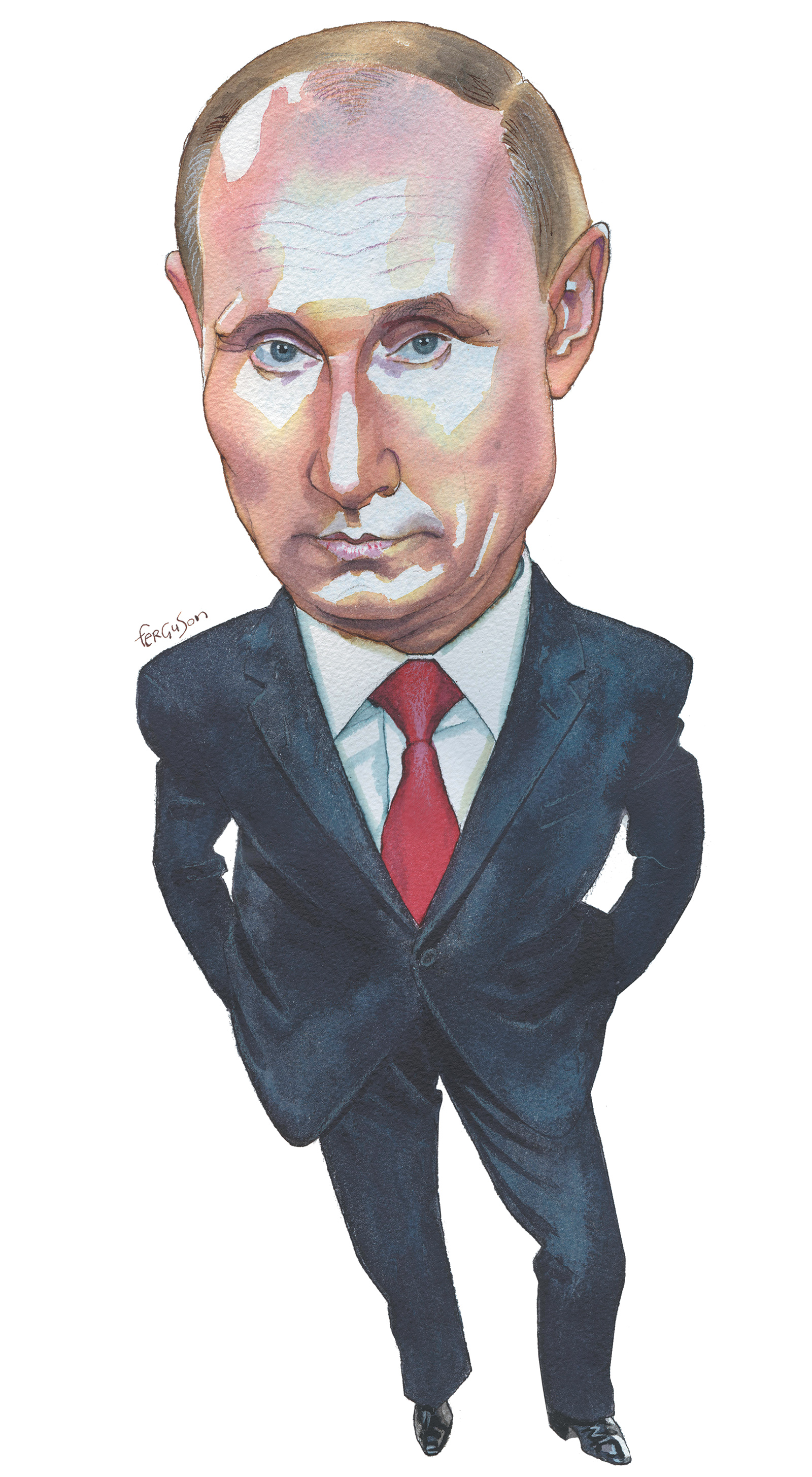
Biographies of political leaders typically offer a seminal moment, preferably early in their subjects’ lives, that crystallizes a character trait or provides a pivotal lesson for the life that follows. In the case of Yuri Andropov, longtime head of the KGB(1967–1982), briefly leader of the Soviet Union (1982–1984), and, most fatefully, patron of the young Mikhail Gorbachev, that moment came in the fall of 1956. From his window in the Soviet embassy in Budapest, Andropov watched in horror as, in the space of a single week in October, a student demonstration swelled into a popular uprising that toppled the Communist government and threatened to remove the Hungarian People’s Republic from the Warsaw Pact and thus from the outer tier of the Soviet Empire.
Through that same window, he could see the bodies of officers of the Hungarian secret police swaying from streetlights. Despite the successful crushing of the uprising by Soviet troops, in the course of which thousands of Hungarian civilians and hundreds of Soviet soldiers were killed, the events in Budapest marked the birth of Andropov’s—and the KGB’s—“Hungarian complex,” the mortal fear of small, unofficial groups sparking movements to overthrow Communist rule with direct (in the Hungarian case) or indirect encouragement by the West.
A generation later, in another Soviet outpost on the western edge of Moscow’s empire, a similar drama unfolded. This time the city was Dresden, the year was 1989, and the outpost was the KGB’s mansion on Angelikastrasse, directly across from the local headquarters of the Stasi, the KGB’s East German counterpart. A crowd of several thousand protesters had successfully breached the Stasi’s gates, gleefully ransacking the building while grim-faced intelligence officers stood by and watched. Also watching, from a window across the street, was thirty-seven-year-old Lieutenant Colonel Vladimir Putin, who was temporarily in charge of the mansion, its voluminous intelligence records, and its staff of four. Shortly after dusk, a small crowd peeled away from the Stasi building with the intent of pulling off a similar victory against the KGB.
According to the New York Times reporter Steven Lee Myers’s gripping account of this oft-told story in The New Tsar, Putin placed an urgent call to the local Soviet military command, requesting reinforcements to protect the mansion, only to be told that nothing could be done without orders from Moscow and that “Moscow is silent.” With his career and a treasure trove of highly classified documents on the line, Putin decided to take matters into his own hands. Approaching the mansion’s outer gates alone and unarmed, he announced in German to the crowd assembled there, “This house is strictly guarded. My soldiers have weapons. And I gave them orders: if anyone enters the compound, they are to open fire.” It worked, at least in one sense: the crowd returned to the Stasi building, leaving the mansion and its contents untouched. But if Putin won the battle, the Soviet Union lost the war.
What lessons did Putin draw from this episode, apart from its subsequent utility for biographical purposes? Haunted by the phrase “Moscow is silent,” he came to regard that silence as symptomatic of a “disease called paralysis—a paralysis of power.” A timely and assertive response to popular protests, it seems, might have produced a better outcome, might have kept Moscow’s East European buffer zone and perhaps the USSR itself intact. The protesters in Dresden that day were for Putin not a crowd but a mob: uninformed (some demanded to see the KGB’s nonexistent torture chambers), loud (some were shouting), and lawless (they ransacked the Stasi’s confidential files). They and their counterparts in Leipzig, Warsaw, Prague, Vilnius, Tbilisi, Baku, and Yerevan were sowers not of transparency but of anarchy.
We needn’t look therefore to the post-Soviet “color revolutions” in Georgia (2003) and Ukraine (2004), let alone to the more recent demonstrations in Moscow against election fraud (2011–2012), for the source of Putin’s visceral aversion to public protests. The groundwork was laid much earlier, and its timing bears on the debate about the current direction of Russian politics. As Putin’s rule has turned more authoritarian and his foreign policy more aggressive, observers have been asking themselves whether something fundamental has shifted in his outlook, and if so, why.
To be sure, like most people who have built their careers inside intelligence services, Putin was never going to be a plausible spokesman for deliberative and pluralist politics. Instead, he has presided over “managed democracy” (managed, that is, by the Kremlin) or “sovereign democracy” (sovereign, that is, vis-à-vis foreign influence)—variations on the Soviet era’s “people’s democracy”—all Potemkin democracies draped over authoritarian structures of power, going back to what Max Weber called the “fake constitutionalism” of the tsarist regime at the beginning of the twentieth century.
Nonetheless, at the beginning of the twenty-first century, what appeared to drive Putin was the sober pursuit of Russia’s national interest after the disintegration and free fall of the 1990s, which he countered by renationalizing the country’s principal assets—oil, gas, and precious metals—and thereby restoring state capacity. Even without getting a sense of his soul, as George W. Bush claimed to have done in 2001, one could recognize Putin as a conservative patriot, a man, to borrow Margaret Thatcher’s assessment of Gorbachev, with whom one could do business.
And business was indeed done: post-Soviet Moscow became home to more billionaires than any other city in the world, even as a prosperous middle class began to spread its wings there and in St. Petersburg and other Russian cities. Business was done across Russia’s borders as well, as China and the European Union became major consumers of Russian oil and natural gas. Putin imposed a semblance of law and a great deal of order at home, while Russia joined or sought to join the multilateral organizations (G8, WTO, OSCE, etc.) that are the benchmarks of global integration. All these trends were widely understood as both cause and effect of Russia’s transition toward “normal” market democracy.
What happened? Why did Putin’s Russia jump the rails? Why is the talk (not to mention the book titles) in the West no longer of transition but regression, with a “new tsar,” a “new Russian empire,” and a “new cold war”? Americans—the quintessential middle-class nation—cherish the notion that a rising middle class expands political freedom and the rule of law; that commerce among nations reduces the threat of war; and that, in the long run at least, democracy produces the greatest good for the greatest number. The distinguished historian Moshe Lewin argued that Gorbachev, Russia’s leading democratizer to date, was part of a rising tide within the Soviet population, an emerging majority of educated, white-collar urbanites, and that perestroika was the product not just of a handful of Communist Party reformers but of the accumulating modernization of Soviet society itself. Deep currents of Russian social history were flowing in the direction of liberalization, and Gorbachev rode the wave.
This notion and the cherished assumptions behind it are now facing historic tests not only in Russia but in China, Poland, and elsewhere. The members of Russia’s middle class who appear in the veteran NPR reporter Anne Garrels’s Putin Country, a survey of life in the provincial city of Chelyabinsk, hardly fit Lewin’s liberalizing mold. Enmeshed in webs of corruption that stretch from ballot stuffing to journalism for hire, from evasion of military service to the auctioning of university admissions, they blame the “everything for sale” mentality precisely on the neoliberalism imported from the West in the 1990s. As one woman puts it, “All those financial manipulations, the rush to privatize, these ideas didn’t come from here, they came from you, from the West, but the West didn’t have to live through the results.” Public protests in Chelyabinsk, however, are extremely rare, since few people can envision a viable alternative to the status quo.
Instead, Garrels’s subjects follow the time-tested Russian strategies of adaptation and circumvention. On the eve of recent elections, for example, students at Chelyabinsk State University were informed that, to express their gratitude for government-issued scholarships, they should support United Russia, Putin’s party. To verify that support, officials required students to use their cell phones to photograph their ballot as they voted. Some students complied with a twist: they placed a thread in the shape of a check mark next to “United Russia,” photographed the ballot, and then removed the thread and voted as they pleased.
According to Authoritarian Russia, by the political scientist Vladimir Gel’man, it is precisely such microstrategies of coping that help perpetuate Russia’s authoritarian politics. Like most politicians, Russia’s leaders are simply “rational power maximizers.” The difference is that they operate in a country almost entirely devoid of institutional and political constraints on elite behavior. Gel’man thus shows little interest in Putin’s worldview, or the views of those around him; in fact, he writes, “ideology as such has probably been the least meaningful factor in Russian politics since the Soviet collapse.”
Putin was able to abolish regional elections of provincial governors and instead appoint them himself, with impunity. His predecessor, Boris Yeltsin, brought in tanks to fire on the popularly elected Russian parliament and rewrote the constitution to fortify executive power, with impunity. Even Anatoly Sobchak, the law professor and first post-Soviet mayor of St. Petersburg (among whose protégés were Putin and his future sidekick Dmitri Medvedev), did not hesitate to dissolve the city council and concentrate power in his own hands, also with impunity.
These were assaults not on individual rivals, opposition parties, or independent media, but on the fundamental structures of the democratic process itself, and yet they generated hardly a ripple of protest. “Almost all success stories of democratization,” Gel’man notes, “result from constraints imposed on would-be dominant actors… by institutions, or by other actors, or sometimes even by themselves.” Rather than parse Putin’s speeches for signs of creeping authoritarianism, or endlessly cite the color revolutions as triggers of the Kremlin’s backlash against civil society, we should recognize that the Russia that emerged from seventy-four years of Soviet socialism was already deeply authoritarian before Putin set foot in the Kremlin.
Indeed, as the political scientist Andrei Tsygankov reminds us in The Strong State in Russia, in the wake of previous catastrophic breakdowns during the past thousand years, whether triggered by rebellion from within or invasion from without (or both), Russia has always reestablished a strong, centralized state. That state has taken a variety of forms, to be sure, but through all of them runs a common trait: the tendency for power to reside in persons more than in institutions. Like most premodern monarchs, the tsars recognized no formal constraints on their authority. And despite the transfer of sovereignty from the tsar’s mortal body to the immortal working class and Communist Party, the Bolsheviks constructed personality cults around Lenin and Stalin that dwarfed anything produced by the sacred monarchies. In Russia there are few signs of institutional or any other domestic constraints emerging in the near future. The new urban middle class, for all its visibility, lacks formal instruments through which to promote its interests. And while Russia may be famous for its fabulously wealthy oligarchs, they have been too busy maneuvering against each other to form an actual oligarchy.
In The Less You Know, the Better You Sleep, the veteran journalist David Satter shares the sense that there has been little change in Putin’s politics, and that the consolidation of authoritarian rule was already well underway in the Yeltsin era. But his analysis of those politics is much darker, focusing on the simmering accusation that in the fall of 1999, Russia’s security services (FSB) directly or indirectly orchestrated a series of bombings of apartment buildings in the cities of Buinaksk, Moscow, Volgodonsk, and Ryazan (the last foiled by alert residents), then falsely claimed that they were the work of Chechen separatists, thus providing a pretext for Prime Minister Putin, previously the FSB’s director, to launch Moscow’s second war against the breakaway republic of Chechnya.
Those accusations were first leveled in 2002 by Yuri Felshtinsky and Alexander Litvinenko, the latter a defector from the FSB who was fatally poisoned four years later by an FSB emissary in London using radioactive polonium 210. Whereas Myers and other authors under review present disturbing evidence but withhold final judgment about responsibility for the bombings, in which nearly three hundred civilians were killed and over a thousand wounded, Satter is convinced that these were acts of state-sponsored terrorism against the state’s own citizens.
He argues moreover that the horrific hostage-taking episodes at the Dubrovka Theater in Moscow in 2002 and at School No. 1 in the North Caucasian town of Beslan in 2004, in which a combined total of over five hundred people were killed, including nearly two hundred children, were “the result of a Russian provocation” designed to further Putin’s consolidation of power in the name of the war on terrorism. Satter’s shocking accusations are not just quantitatively but qualitatively different from those linking Russian authorities to the assassination of vocal critics such as Paul Klebnikov (2004), Anna Politkovskaya (2006), Anastasiya Baburova and Stanislav Markelov (2009), Natalya Estemirova (2009), and Boris Nemtsov (2015)—to name only the most prominent cases. The victims at the Dubrovka and in Beslan, like those of the apartment bombings, were not critics but anonymous, random targets of lethal violence, which is to say, of terrorism.
These charges, as Satter recognizes, boggle the mind. To understand today’s Russia, he insists, “is actually very easy, but one must teach oneself to do something that is very hard—to believe the unbelievable,” because “Russia is a universe based on a completely different set of values.” German Chancellor Angela Merkel arrived at a similar conclusion in March 2014, following a telephone conversation with Putin in the midst of Russia’s annexation of the Crimean peninsula. Merkel reported afterward to President Obama that Putin was out of touch with reality, living “in another world.” One needn’t fully share this Manichaean perspective to conclude that Gel’man’s “rational power maximization” cannot adequately capture what drives Putin—or any other politician. To put it another way, it fails to grapple with John Maynard Keynes’s dictum that “the power of vested interests is vastly exaggerated compared with the gradual encroachment of ideas.”
According to Putinism, by longtime Russia observer Walter Laqueur, Keynes’s pronouncement should apply particularly to Russia, which even today is unable “to exist without a doctrine and a mission.” The Soviet Union from which Russia emerged in 1991 was the most purpose-driven society the world has ever seen. Yet Laqueur struggles to put his finger on what he calls “the emerging ‘Russian idea,’” partly because so many doctrines are competing for influence (Russian Orthodoxy, Eurasianism, antiglobalism, nationalism), and partly because, as he concedes, the vast majority of ordinary Russians “are not motivated by ideology; their psychology and ambitions are primarily those of members of a consumer society.” The ubiquity in contemporary Russian political thought of fantastic conspiracy theories periodically leads Laqueur to throw up his hands in frustration. At one point he concludes that, apart from a vague “nationalism accompanied by anti-Westernism,” “there might be no elaborate Putinist ideology” after all.
FinancialTimes reporter Charles Clover takes a different approach to the role of ideas in Putin’s Russia.Black Wind, White Snow—a phrase borrowed from Alexander Blok’s apocalyptic 1918 poem “The Twelve,” about Bolshevik apostles ushering in a new age—offers a highly person-centered (and thus appropriately Russian) history of “Eurasianism,” a keyword among today’s Russian conservatives. Like Blok, the original Eurasianists (many of them exiles in interwar Europe) sought to reconcile themselves to the Soviet project by recasting its historical meaning. Beginning with the aristocrat Nikolai Trubetskoy, they made their peace with Bolshevism as the only available means to insulate Russia from the violent self-absorption of a European civilization in steep decline.
Eurasianism began as an imaginative—to put it generously—theory of historical linguistics, allegedly showing that Russian tonal patterns had more in common with those of the steppe peoples of Inner Asia (“Eurasia”) than with Europeans’. For Trubetskoy and his collaborator Roman Jakobson, moreover, linguistic structures captured and preserved deep affinities of culture and consciousness, rendering visible, to the trained eye, the true frontiers of a great Eurasian civilization that had amalgamated dozens or even hundreds of tribes in a single “convergence zone.” From here it was a short step to declaring that Russia was neither a Slavic nor a European country, that in fact most of Russia’s problems came from trying to be European when it wasn’t. Better to recognize and embrace one’s inner Mongol. The most fertile Eurasianist of all was Lev Gumilev, whose story Clover relates in a series of utterly absorbing chapters. The offspring of two of modern Russia’s greatest poets, Anna Akhmatova and Nikolai Gumilev, Lev Gumilev seems to have passed through all of his country’s twentieth-century agonies to emerge a profound and profoundly damaged thinker. During his decade as a zek (prisoner) in the Gulag, he became a keen observer of human relations in the primordial setting of the camps, developing categories of analysis that we would now recognize as belonging to evolutionary psychology and sociobiology. Rather than a Hobbesian war of all against all, Gumilev found that prisoners naturally organized themselves into microcommunities:
Groups of from two to four persons emerged on this principle; they “eat together,” that is, share their meal. These are real consortiums, the members of which are obliged to help each other. The composition of such a group depends on the internal sympathy of its members for each other.
Internal sympathies, or what Gumilev called “complementarity,” led members of such communities to defend and make sacrifices for each other in ways that cannot be explained solely via rational self-interest (let alone rational power maximization). He called these prerational or suprarational impulses “passionarity,” a New Testament–tinged neologism signifying the instinct for self-sacrifice on behalf of a greater collective good.
Gumilev’s time in the camps was interrupted by service in the Red Army toward the end of its epic battle against Nazi Germany. Compared to the Gulag, he wrote, “the front line felt like a resort.” As he approached Berlin in the spring of 1945, Gumilev struggled to make sense of how a backward, motley country like the USSR could have overcome superior German organization and technology. Amid the “ornate books,” “asphalted roads,” and “luxurious apartments and automobiles,” Gumilev and his fellow Soviet soldiers, “dirty and unshaven, stood and wondered, why are we stronger? How are we better than this immaculately groomed and shiny country?” His eventual answer: Eurasians’ higher coefficient of complementarity and passionarity.
Gumilev went on to write a slew of works, intricate, inspired, and ill-equipped to withstand scholarly scrutiny, culminating in the long-delayed publication of his Ethnogenesis and the Biosphere (1989), which was all the rage when I was a graduate student in Leningrad. With the Soviet Eurasian state disintegrating around him, Gumilev’s Stockholm syndrome, as Clover calls it, came into full bloom: he rose to public prominence as an ardent defender of the very state that had executed his father, silenced his mother, nearly starved and worked him to death for twelve years, and murdered millions of his fellow Eurasians. Was this Gumilev’s version of passionarity?
After his death in 1992, his fame only increased. Eurasianism offered a renovated moral purpose for the multi-national USSR (and for a possible successor state) that was neither Marxist nor nationalist, a “third way,” as Clover puts it, emphasizing “the unconscious sympathy of the people of the Soviet Union, the millennia-old unity of inner Eurasia, and a lurking distrust of the West.” It is easy, and not entirely wrong, to dismiss such sentiment as a fig leaf for Russian imperial ambitions. But it is worth recalling that Russians have never inhabited the nation-state form; for centuries they have been accustomed to living in multinational polities, always as the dominant ethnic group but rarely with the ambition to become the only ethnic group.
In the post-Soviet chapters of Black Wind, White Snow, Eurasianism’s lineage starts to unravel. Clover looks to Alexander Dugin, a prodigious right-wing intellectual impresario, to carry the banner raised by Trubetskoy and Gumilev, but the diversity of sources on which Dugin draws—nationalist, fascist, postmodern—makes him an uncomfortable fit. Clover’s method for establishing Dugin’s and Eurasianism’s influence on the Kremlin is similarly unconvincing, focusing entirely on the occasional appearance in Putin’s speeches of keywords such as “passionarity” or “Eurasia.” One could just as easily cite other keywords uttered by Putin in order to draw the attention of other constituencies, a technique Clover correctly identifies as the “dog whistle.” While Eurasianism has clearly found its way into the rhetorical stew from which Russian political elites feed, and periodically provides ideological gloss for this or that initiative, there is little evidence that it has actually shaped Kremlin policies, whether at home or abroad.
If there is one arena in which Russia’s “power maximizers”—rational or otherwise—bump into unavoidable constraints, it is in the conduct of foreign policy. Simply by virtue of its size and the number of its neighbors (both greater than any other country), Russia remains a global player. But as the Australian scholar-diplomat Bobo Lo persuasively argues in Russia and the New World Disorder, Moscow has yet to adapt to the disorder of the post–cold war world or to the limited efficacy of “hard power” and adversarial paradigms.
To be sure, Putin has demonstrated considerable skill in the arts of soft power. Much has been made of his election-year comments concerning Donald Trump, especially by Trump himself, who brags about Putin calling him “brilliant” and “a genius.” Actually, the word Putin used was yarkii, “colorful” or “flamboyant,” a description with which it would be hard to disagree.
More significant—and more alarming—than any mutual flattery between the two autocratic figures, however, have been the financial ties between the Trump camp and a range of Putin’s allies. Paul Manafort, who resigned as Trump’s campaign manager on August 19, previously sold his services to Viktor Yanukovych, the Ukrainian leader whose ousting in February 2014 led to Putin’s annexation of Crimea and invasion of eastern Ukraine, as well as to Oleg Deripaska, a billionaire aluminum magnate and Putin confidante who was banned from entering the United States. Carter Page, one of Trump’s foreign policy advisors, formerly worked for Russia’s state-owned energy company Gazprom. Trump himself, after his hotel and casino business went bankrupt in 2004, benefited significantly from infusions of capital that originated with Russian oligarchs.
For Putin, Trump represents not just a man with whom the Kremlin can do business, but potentially the most useful among the cohort of ultra-nationalists, including Nigel Farage in Britain, Marine Le Pen in France, and Geert Wilders in the Netherlands, who are leading the latest assault on globalization, neoliberalism, and the Western alliance system—this time from within. But whatever drove the Kremlin to hack the DNC’s e-mail, and whatever inspired Putin to express oblique praise for Trump, neither action seems to be helping Trump’s campaign—on the contrary. This may well be another example, as in Dresden in 1989, of Putin winning the battle but losing the war. It may also be a sign that, in Russia as in the US, all politics is local, and that Putin’s actions in the US election are designed primarily to bolster his domestic image as a master of political intrigue. Here, he appears to be succeeding.
Putin has also waged a soft-power irredentist campaign to mobilize millions of ethnic Russians and Russian speakers in the “near abroad,” the former Soviet republics that now ring Russia’s western and southern flanks. And where a Russian political diaspora cannot be found, the political analyst Agnia Grigas shows inBeyond Crimea, Moscow creates one: via humanitarian assistance, media saturation, and widespread granting of Russian passports. But these efforts to recoup at least some of what was lost in 1991 have been both selective and opportunistic.
Even in the most dramatic examples, in Georgia and Ukraine, Putin appears once again to be winning battles but losing wars. Having skillfully annexed the Crimean peninsula and locked eastern Ukraine, Abkhazia, and South Ossetia into protracted conflict, Moscow has effectively pushed the rest of Ukraine and Georgia more firmly than ever toward the European Union, while setting off a punishing regime of sanctions against Russia by the West. Other former Soviet republics now look with greater wariness at Putin’s proposed “Eurasian Union,” and NATO is beefing up its mission in Estonia, Latvia, and Lithuania.
Is Putin’s newly assertive stance a symptom of “reimperialization,” as Grigas insists, or rather of what Lo calls the “prolonged agony of post-imperial adjustment,” not unlike the Anglo-French attempt to occupy the Suez Canal in 1956, or the brutal French war in Algeria in the 1950s? “It is unrealistic,” Lo reminds us,
to expect Russia to be the exception to the rule that empires, modern and ancient, do not go quietly. They either collapse as a result of crushing defeat (Germany, Japan) or domestic implosion (China), or they strive for decades to cling on to the scraps of their imperial past (Great Britain, France). Less than twenty-five years ago, Russia was the largest land empire in history. The current political generation was born and raised in imperial times.
One needn’t subscribe to the theory of Eurasian “complementarity” to grasp that, with decades or even centuries of cohabitation by Russia and its former imperial holdings, and without oceans or other natural borders to separate them (apart from the Caucasus), Russia is unlikely to go quietly anytime soon.
A Princeton PhD, was a U.S. diplomat for over 20 years, mostly in Central/Eastern Europe, and was promoted to the Senior Foreign Service in 1997. After leaving the State Department in 2003 to express strong reservations about the planned U.S. invasion of Iraq, he shared ideas with Georgetown University students on the tension between propaganda and public diplomacy. He has given talks on "E Pluribus Unum? What Keeps the United States United" to participants in the "Open World" program. Among Brown’s many articles is his latest piece, “Janus-Faced Public Diplomacy: Creel and Lippmann During the Great War,” now online. He is the compiler (with S. Grant) of The Russian Empire and the USSR: A Guide to Manuscripts and Archival Materials in the United States (also online). In the past century, he served as an editor/translator of a joint U.S.-Soviet publication of archival materials, The United States and Russia: The Beginning of Relations,1765-1815. His approach to "scholarly" aspirations is poetically summarized by Goethe: "Gray, my friend, is every theory, but green is the tree of life."
 Georgetown Book ShopCan you guess who the victims were of the largest mass-lynching in American history and where it took place? Most people would, I think, guess blacks first, then maybe Mexicans or Native Americans. And we'd assume it was somewhere in the old Confederate states. Writing in the Boston Globe, Jeff Jacoby notes that the 18 men and boys killed on October 24, 1871 were chosen dragged out of their houses and beaten and hanged because they were Chinese. The locale wasn't Alabama or Mississippi, either. It was Los Angeles, California.
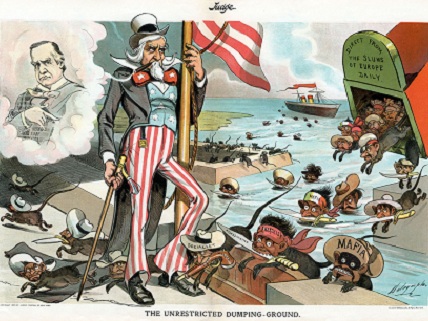
 Wikimedia, public domainIf Mexicans are the enemy within—all this talk of deporting millions of undocumented immigrants is mostly aimed at them—China has mostly replaced Russia or Japan as our major enemy without. Hillary Clinton, Bernie Sanders, virtually all of the failed GOP candidates for president, and especially Donald Trump mince no words in saying they will hold China accountable for flexing its regional military might, "manipulating" its currency (something all national central banks do simply by existing), and especially "stealing" American jobs. And of course, Chinese immigrants in America threaten "us" in a way that is less like low-skilled Mexicans and more like the fears stoked by Jews back in the early 20th century: Chinese kids are so super-smart, especially in math and engineering, right, that they aren't taking manual-labor gigs away from low-income, low-skilled natives? They're taking away all the slots at the University of California system and maybe even the Ivy League! They're not human, they work too hard!