Thursday, September 20, 2018

Empowering Polarizing US Polarization ... a Note on the Important NYT article, 'The Plot to Subvert an Election Unraveling the Russia Story So Far"


From Facebook (slightly edited)


In my modest opinion, this well-researched article [too long for technical reasons to post on this blog] illustrates how the Kremlin "figured" (not so naively) that it would be easy -- and "cost effective/cheap," with the use of computers -- to further polarize its already polarized favorite enemy-du-jour: the USA.


About this website
NYTIMES.COM
For two years, Americans have tried to absorb the details of the 2016 attack: spies, leaked emails, social media fraud — and President Trump’s claims that it’s all a hoax. The Times explores what we know and what it means.


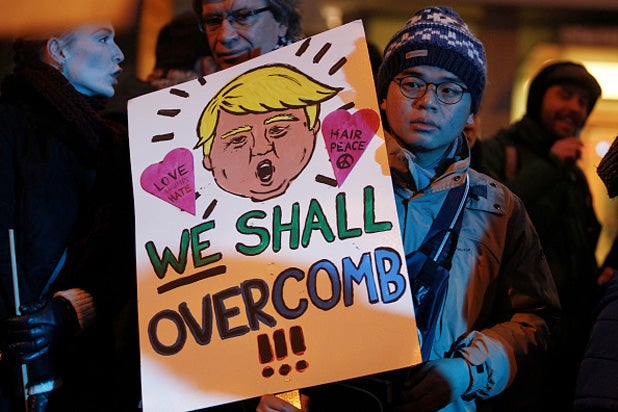
Latest News! WH Peacenik Comes out of the Closet!


John Solomon and Buck Sexton, "Trump slams Bush for ‘worst single mistake’ in U.S. history," thehill.com; original article contains a video; see also (1) (2).

***
In all fairness to Trump, pls. note the rather ambiguous sentence in the below: "Different estimates exist on the costs of the U.S. wars in Iraq and Afghanistan, which Trump has frequently criticized." Q: Was the president as stated in the article referring to the wars themselves, or to their cost/different estimates of their cost?


Image result for Trump peace sign long hair
image (not from article) from

President Trump took a little time during a policy-rich interview in the Oval Office to give his take on the biggest mistake in American history.

Was it the Civil War? Nah. The failure to stop Sept. 11? Nope. How about Pearl Harbor? Not even close.

“The worst single mistake ever made in the history of our country: going into the Middle East, by President Bush,” the president said during an exclusive interview with Hill.TV. “Obama may have gotten (U.S. soldiers) out wrong, but going in is,to me, the biggest single mistake made in the history of our country.”

So why was it so catastrophic?

“Because we spent $7 trillion in the Middle East. Now if you wanna fix a window some place they say, 'oh gee, let’s not do it.' Seven trillion, and millions of lives — you know, ‘cause I like to count both sides. Millions of lives,” the president explained.

“To me, it's the worst single mistake made in the history of our country. Civil war you can understand. Civil war, civil war. That’s different. For us to have gone into the Middle East, and that was just, that was a bad day for this country, I will tell you.”

Different estimates exist on the costs of the U.S. wars in Iraq and Afghanistan, which Trump has frequently criticized.

A recent estimate by Brown University put the cost, as of September 2017, and $5.6 trillion, a total that includes costs associated with the two U.S. wars, military action related to Pakistan and Syria, homeland security expenses and health-care costs for veterans of the wars.

The Pentagon estimates total expenditures related to the wars in Iraq, Afghanistan and Syria between 2001 and 2018 are $1.52 trillion.

Wednesday, September 19, 2018

How Connected Is Your Community to Everywhere Else in America? Note for a Discussion, "E Pluribus Unum? What Keeps the United States United."


By Emily Badger and Quoctrung Bui, The New York Times, Sept. 19, 2018; regrettably the informative charts in this article cannot be reproduced on this blog

Image result for USA connected
image (not from article) from
Excerpt:
America is often described as a place of great divides [JB emphasis] — between red and blue, big cities and rural towns, the coasts and the heartland. But our social lives are shaped by a much stronger force that ignores many of these lines: distance.

In the millions of ties on Facebook that connect relatives, co-workers, classmates and friends, Americans are far more likely to know people nearby than in distant communities that share their politics or mirror their demographics. The dominant picture in data analyzed by economists at Facebook, Harvard, Princeton and New York University is not that like-minded places are linked; rather, people in counties close to one another are.

Even in the age of the internet, distance matters immensely in determining whom — and, and as a result, what — we know.

Coastal cities like New York, Washington, San Francisco, Boston and Los Angeles do exhibit close ties to one another, showing that people in counties with similar incomes, education levels and voting patterns are more likely to be linked. But nationwide, the effect of such similarity is small. And the pull of regionalism is strong even for major cities. Brooklynites are still more likely to know someone on Facebook near Albany or Binghamton than in the Bay Area. ...

Counties with more dispersed networks — where a smaller share of Facebook friends are located nearby, or among the nearest 50 million people — are on average richer, more educated and have longer life expectancies. Places that are more closely connected to one another also have more migration, trade and patent citations between them.

Counties that are more geographically isolated in the index are more likely to have lower labor force participation and economic mobility, and they have higher rates of teenage births. Some of the most economically distressed parts of the country appear to be the most disconnected: Among the 10 U.S. counties with the highest share of friends within 50 miles, six are in Kentucky. ...

Ancestry.com changed how it determines ethnicity and people are upset - Note for a Discussion, "E Pluribus Unum? What Keeps the United States United."


USA TODAY NETWORK, Marc Daalder, Detroit Free Press; original article contains a video

Ancestry.com, the website better known for helping users create family trees, find distant family members and capture suspected serial killers, made a lot of customers angry last week.
Ancestry, which also is in the business of DNA testing, allows users to send a vial of saliva to the company and receive in return a detailed genetic portfolio, including risk for some diseases and estimates of their ethnic ancestry.
Neither the medical nor the heritage information are guaranteed to be 100 percent accurate, but as the science improves, so does the quality of the results. At least, that's what Ancestry insists.
After Ancestry rolled out a new update to its ethnicity estimate system last week, users noticed dramatic changes in their ethnic profiles – some of which is inaccurate, customers say.
The science is simple: Ancestry compares sections of your DNA with a "reference panel" of DNA samples that it knows correspond to a certain place (say, Italy or southern Africa) to try to identify a match. The new update expands the reference panel by a factor of five, so it should be more accurate.
Still, many users remain angry with Ancestry as their original results have, in some cases, drastically changed.
Other users said they were happy with the results or found that the new results better matched what they knew of their family history.
In April it was revealed DNA from a decades-old crime scene was plugged into a genealogy website. Investigators followed family trees to try to narrow down a suspect. That search led to Joseph James DeAngelo. 
DeAngelo is suspected of being the Golden State Killer serial killer. DeAngelo, who lived in the Sacramento suburb of Citrus Heights when he was arrested in April, is accused in 12 killings, more than 50 rapes and the ransacking of more than 100 homes across California in the 1970s and 1980s. 
A spokesperson for Ancestry.com, which also has a search for the general public, said the company was not in contact with authorities in the DeAngelo case and will not share member information with law enforcement "unless compelled to by valid legal process."
At the time, Ancestry.com said it was unaware of the investigation.
Contributing: Christal Hayes and Ashley May, USA TODAY. Follow Marc Daalder on Twitter: @marcdaalder

Sunday, September 16, 2018

Three Blockbuster Novels From the 1950s, and Their Remarkable Afterlife


By Sam Tanenhaus, The New York Times, Sept. 12, 2018; original article contains additional illustrations

Pasternak image from article

Why are Russians so good at vexing American minds? Vladimir Putin’s bewitchment of President Trump continues to frustrate intelligence officials and at times hard-liners in his own administration, while pro- and anti-Russia journalists trade insults as enthusiastically as they did during the 1950s Rosenberg spy trial.

Beneath this lurks the uneasy feeling that our longtime superpower adversary remains our secret twin, matching us in audacity and ambition, just as it did all those years ago. “Listen now,” an NBC radio announcer declared in October 1957, “for the sound which forever more separates the old from the new.” The sound was the beep-beep of the radio signal emitted by Sputnik, the first satellite sent into space, as it streaked on its elliptical path at a surreal velocity of 18,000 miles per hour. The Russians’ early conquest of space came as a shock — “perhaps the darkest hour of the Cold War,” one historian has written — but it was also an exciting communal moment: Americans stumbled out of bed to watch “the sunlit speck sweep across the predawn sky,” Time reported, “as steady in its orbit as the made-by-nature moon.”

The “space race” was a competition, but with only two rivals — “us” and “them.” And this odd partnership, or dance, spilled over into realms of the imagination, particularly the novel. In the aftermath of Sputnik three towering and best-selling works of fiction by dissident Russians — “Atlas Shrugged,” “Lolita” and “Doctor Zhivago” — were published in quick succession, crowded into an 11-month span, from October 1957 to September 1958. Today, all three still live on, each a universe in itself, read and discussed — and fought over — as if written not in prose but in hieroglyphics or code.

Published less than a week after the Sputnik launch, “Atlas Shrugged” was the crowning work of Ayn Rand, a Jewish émigré from St. Petersburg (born Alissa Rosenbaum) who had gone to Hollywood in the 1920s, taking with her scenarios even Cecil B. DeMille’s story department deemed far-fetched. It was there that she developed an almost militant faith in capitalism. Her novel “The Fountainhead,” published in 1943, though panned by reviewers, became a word-of-mouth sales triumph and then a film starring Gary Cooper as a visionary architect modeled on Frank Lloyd Wright.

Since then Rand had carefully tended her own growing legend. The immense “Atlas Shrugged” (1,168 pages) was famous even before it was published — the fruit of 13 years of intense work — with amphetamine-driven live readings for her entranced circle, or cult, of young acolytes, who gathered at her apartment in Manhattan.

Devotees of “Atlas Shrugged,” then and now, thrill to its über-size heroes — the inventor-genius Hank Rearden, the svelte, steely Dagny Taggart, who talk at exhausting length about the holiness of the profit-motive — “money demands of you the highest virtues” — and then clang together in steamy sex scenes (“He held the length of her body pressed to his, as if their bodies were two currents rising upward together, each to a single point, each carrying the whole of their consciousness to the meeting of their lips”). Rand’s libertarian followers exulted in her rogues’ gallery of evil statists, who are dragging America into a condition of primitive decline: greedy labor bosses, “modern college-infected parasites who assumed a sickening air of moral self-righteousness,” conformist “watchdogs” at the “Bureau of Economic Planning and National Resources,” “State Science Institute” and “Consumers’ Protection,” who have created a permanent proletariat of “moochers and looters,” “loafers” and “bums.”

To many in the late 1950s this sounded crazily off-key. These were peak years of the “affluent society” and a golden age for entrepreneurs. President Eisenhower had stocked his cabinet with captains of industry like Charles Wilson, brought in from General Motors to run the Defense Department. The Cold War battle for the heavens soon yielded a billion-dollar-a-year “space industry,” with lucrative government contracts showered on businesses large and small — from giant aircraft companies like Lockheed to Waste King, a maker of garbage disposals.

But Rand sensed something else. America’s great industrialists were becoming clients of the state. The advance guard of Cold War planners, space and weapons theorists like J. Robert Oppenheimer, John von Neumann and James R. Killian, the president of M.I.T., chosen by Eisenhower to oversee the creation of NASA, were administrators rather than doers, unlike the executives at New York Central Railroad and Kaiser Steel whom Rand had interviewed while writing “Atlas Shrugged.” The Promethean Hank Rearden is a throwback, a metal engineer who helps develop “a motor that would draw static electricity from the atmosphere, convert it and create its own power,” making possible a “brand-new locomotive half the size of a single Diesel unit, and with 10 times the power.” In the emerging era of the R-7 missile and the multistage rocket, this motor (actually the invention of John Galt, the novel’s mysterious hero) seemed archaic — a “Swiftian device,” The New Yorker’s critic wrote. “I am speaking, of course, of Tom Swift,” the young inventor in the series of books for boys.

But that was exactly what Rand meant to do, to reawaken respect for what one character calls “the highest type of human being — the self-made man — the American industrialist.” And Rand’s readers were intensely grateful. “For 25 years I’ve been yelling my head off about the little realized fact that eggheads, socialists, Communists, professors and so-called liberals do not understand how goods are produced,” wrote one, the owner of the Standard Slag Company in Youngstown, Ohio.

And if those useful goods weren’t produced, hard times would come. Rand’s dystopian picture feels prescient — “the slovenly dilapidation of slum hovels,” the “command” economy that overwhelms ordinary citizens “who never looked beyond the span of one week,” and were pacified by the “large new television set in the lighted room of a house with a sagging roof and cracking walls.” Rand’s prevision of American carnage drew on memories of her Russian girlhood, first of the Bolshevik Revolution and then of the “transition period under Lenin from a primitive capitalism to a brutal Communism,” Anne C. Heller writes in “Ayn Rand and the World She Made.”

Americans, Rand suggested, were listening for the wrong signals — seduced by the metal orb speeding across the sky, and the organized miracle of the Soviet “Virgin Lands” program and its otherworldly grain yields. Rand’s novel called attention to very different facts of life in the Soviet empire: chronic meat shortages, inadequate housing, oppressed populations in revolt (including the recent Hungarian uprising, quashed by Soviet tanks). “Atlas Shrugged” is a nightmare picture not of America as it was in 1957, but of the ersatz Soviet Union it might become.

But to many, Rand’s philosophy of “rational selfishness” seemed as harsh and limited as the Russians’ materialism. It reinforced the suspicion that the two superpowers, locked in their global and now interplanetary competition, had both misplaced their souls. Redemption came in another of the post-Sputnik Russian epics, Boris Pasternak’s “Doctor Zhivago,” which tells the story of the Russian Revolution as Tolstoy might have done it — not as an ideological tract or political commentary, but as a multilayered narrative. Zhivago and his lover, Lara — together with five dozen other characters sprawling over three generations — struggle and suffer through the critical period in Russian history, from the 1905 revolution into the Bolshevik Revolution and World War I, and the subsequent civil war, at first inspired but ultimately disillusioned by the new Soviet regime.

Never was so conventional a novel so rapturously received, at least in the West, especially after the Russians refused to publish it, and then, when smuggled translations began selling in vast numbers abroad, heaped abuse on Pasternak and made him turn down the 1958 Nobel Prize. The “traitor Boris Pasternak” was officially urged to “become a real emigrant” — instead of an internal one — “and go to his capitalist paradise.” In a country where nearly 1,500 writers had either been killed or had died in labor camps, this was not a subtle hint. But Pasternak, a revered poet and a courageous one, didn’t give in. He stubbornly stayed in Russia, in a bungalow outside Moscow, though he would have been welcome as a hero anywhere in the West. At an anti-Communist rally in Vienna sponsored by Roman Catholic student and youth organizations, a montage of photos “made him appear to be standing behind barbed wire,” The Times reported. “From a distance he seemed to be wearing a crown of thorns.” By this time sales of his novel in the United States alone had reached 850,000 copies.

It wasn’t just Cold War politics that excited readers. On the contrary, Pasternak’s subjects were faith and redemption, death and resurrection. He discussed Communism as Western ex-Communists did, as the romantic “god that failed.” Zhivago laments how the original Marxist ideal — “young men dying on the barricades, writers racking their brains in an effort to curb the brute insolence of money, to save the human dignity of the poor” — is betrayed by the rigid dogma of the Soviet state and so was flawed all along, as any dream of salvation through politics must be. The only answer, Zhivago realizes, is to escape politics altogether and seek a “new way of living and new form of society, which is born of the heart, and which is called the Kingdom of Heaven,” and rests in the truth of Christ’s timeless parables. “The idea that underlies this,” Zhivago explains, “is that communion between mortals is immortal, and that the whole of life is symbolic because it is meaningful.”

Zhivago and Lara’s “conversations, however casual, were as full of meaning as the dialogues of Plato,” Pasternak writes. Perhaps. But his own homilies read less like Tolstoy than like the mock-Russian hilarities in Woody Allen’s “Love and Death.” At the time, however, astute and august critics were mesmerized. One of them, Edmund Wilson, argued that Pasternak presented a “radical criticism of all our supposedly democratic but more and more centralized societies.” William F. Buckley Jr., praising “Doctor Zhivago” from the right, wrote, “The elaborate edifice of Marxism-Leninism crumbles before the poet’s eye of Boris Pasternak.” The secret genius of “Doctor Zhivago” was that it gave comfort to everyone, even the Soviet premier Nikita Khrushchev when he finally got around to reading it. “We shouldn’t have banned it,” he conceded. “There’s nothing anti-Soviet in it.”

This was also the opinion of the author of the third post-Sputnik classic, the ferociously anti-Communist Vladimir Nabokov, though he had a personal reason for disliking “Doctor Zhivago.” It had bumped his novel “Lolita” off the top rung on the Times best-seller list. He had a second reason too. An important incident early in Pasternak’s novel — Lara’s sexual ravishment, at age 16, by a much older man — pre-empted Nabokov’s explicit story of the rape of a 12-year-old by the narrator, Humbert Humbert, who is three times her age. Like the other post-Sputnik novels, “Lolita” had its own pre-publication tumult, in this case an obscenity scandal. American publishers were afraid to release it, so it had come out in Paris, and it was banned there too, becoming prize contraband. But after a large portion of it was serialized in The Anchor Review, it was at last deemed acceptable for American readers.

They were surprised by what they found. Sexual sin was a familiar subject in the late 1950s. The period’s best sellers included “Peyton Place,” “By Love Possessed” and “Anatomy of a Murder.” But these were all conventional middlebrow novels. Nabokov was a highbrow genre-changer, an originator of postmodern techniques: wordplay, stories constructed like puzzles, layers of allusion, tricks of misdirection.

If Rand and Pasternak were fabulists dabbling in realism, Nabokov was the opposite, a literary magician, with a dandy’s lush prose style, whose story was based on a shockingly thorough knowledge of facts on the ground. In her new book, “The Real Lolita,” Sarah Weinman maps the parallels between Humbert’s case and one true-crime episode mentioned in “Lolita,” the abduction of a fifth grader by a 50-year-old pedophile in Camden, N.J., who fled with her on a cross-country spree. But that was just one story among many in what later came to be called the “postwar sex crime panic.” Ordinary readers were well-versed in such stories. They were staples of the so-called family magazines. A cover story in The American Magazine in 1947 — when much of “Lolita” takes place — was “How Safe Is Your Daughter?” Not safe at all, according to the author, the F.B.I. director J. Edgar Hoover. “The most rapidly increasing type of crime is that perpetrated by degenerate sex offenders,” he wrote, going on to offer a selection, complete with lurid details, of a nationwide binge of rape and pedophilia, a “criminal assault every 43 minutes, day and night, across the United States.” There was, for instance, the case of the 17-year-old jailed on a sex charge who “three weeks after his release lured an 11-year-old girl to an open field, where his brutal attacks ended in the murder of the child.” Another family magazine, Collier’s, published a series, “Terror in Our Cities.” And there was more in the daily press — tales of grown men who plied underage girls with “sodas and sundaes,” teenage sex rings involving girls as young as 13 (all “said to be from good families”).

What was surprising, in 1958 no less than today, was the indifference of the nation’s most sophisticated readers, its literary critics, to the connection between Humbert’s ensnared “lover” and “the real Lolitas who exist in darkness throughout their lives,” as The New Republic pointed out in an editorial. It was the familiar story of clueless elites, and it rested on intellectual complicity. Advanced midcentury thinking had all but discarded the categories of “normal” and “abnormal” sexual conduct. In his book “Sexual Behavior in the Human Female,” the sexologist and data-accumulator Alfred C. Kinsey wrote that “adult contacts are a source of pleasure to some children, and sometimes may arouse the child erotically (5 percent) and bring it to orgasm (1 percent).” And of the “80 percent of the children who had been emotionally upset or frightened by their contact with adults,” Kinsey, a trained entomologist, concluded, “in most instances the reported fright was nearer the level that children will show when they see insects, spiders or other objects against which they have been adversely conditioned.”

Nabokov was an accomplished butterfly collector, well versed in scientific jargon, real and fake. In a mock foreword to “Lolita,” Humbert’s story is described, in pitch-perfect Kinsey-ese, as the “confession of a White Widowed Male.” His story, the author adds, “should make all of us — parents, social workers, educators — apply ourselves with still greater vigilance and vision to the task of bringing up a better generation in a safer world.” It was easy to feel in on the joke, just as it was easy to share in the snobbery when Nabokov wrote, “Nothing is more exhilarating than philistine vulgarity.” But you could also miss what he was really saying, that America had mass-produced its own version of Old World decadence. The same consumer culture that infantilized adults — with “cute paper napkins and cottage-cheese crested salads” and “‘raid-the-icebox’ midnight snacks” — was also sexualizing their children and making them prey to pedophiles. Grown-ups and “bobby-soxers” alike were in thrall to the “luminous globules of gonadal glow that travel up the opalescent sides of jukeboxes,” and also huddled together in the “dim, impossibly garnet-red light that in Europe years ago went with low haunts, but here meant a bit of atmosphere in a family hotel.” Humbert, posing as Lolita’s father, is a sinister parody of the overprotective “helicopter” parent, rebuked by Lolita’s teachers for being an “old-fashioned Continental father” who forbids his “daughter” to mix with boys her own age. Viktor Komarovsky, the sexual predator in “Doctor Zhivago,” would have had an easy time of it in Nabokov’s America.

Each of these three novels has had a remarkable afterlife. “Lolita” is a virtual guidebook to the abuses exposed by the #MeToo movement — the secret predations of the mentor and teacher who operates in a free zone of “enlightened” complicity. “Doctor Zhivago” endures less as a novel than as a peak episode in the cultural Cold War. Publishers in America and Britain recently paid large advances to a young novelist who has told the story again, drawing on declassified documents on the secret C.I.A. operation that smuggled the manuscript back into Russia. And “Atlas Shrugged” remains a free market Bible on the right. What one of its most scathing early critics, the ex-Communist journalist Whittaker Chambers, identified as Rand’s appetite for “smashing up the house” has become the stated cause of several generations of Republicans and libertarians. The House speaker, Paul Ryan, with his mission to undo the Affordable Care Act and its coddling of “takers,” while slashing taxes on high-income “makers, ” is a devout Randian, as are members of the Trump cabinet. Silicon Valley abounds with Randians, too.

Meanwhile Russian cyberhackers have reportedly begun to disrupt the 2018 midterm elections. More than a quarter-century after the Soviet Union dissolved, Russia remains in many respects our doppelgänger, and the cry is heard, in ever more plaintive tones, “where is the collusion?” The answer — as all three of the great post-Sputnik prophets of the novel tried to tell us — is everywhere.

Sam Tanenhaus, a former editor of the Book Review, is writing a biography of William F. Buckley Jr.

The American Past: A History of Contradictions - Note for a Discussion, "E Pluribus Unum? What [still?] Keeps the United States United."


Review by Andrew Sullivan, The New York Times, Sept. 14, 2018:

THESE TRUTHS
A History of the United States
By Jill Lepore
Illustrated. 932 pp. W.W. Norton & Company. $39.95.


It isn’t until you start reading it that you realize how much we need a book like this one at this particular moment. “These Truths,” by Jill Lepore — a professor at Harvard and a staff writer at The New Yorker — is a one-volume history of the United States, constructed around a traditional narrative, that takes you from the 16th to the 21st century. It tries to take in almost everything, an impossible task, but I’d be hard-pressed to think she could have crammed more into these 932 highly readable pages. It covers the history of political thought, the fabric of American social life over the centuries, classic “great man” accounts of contingencies, surprises, decisions, ironies and character, and the vivid experiences of those previously marginalized: women, African-Americans, Native Americans, homosexuals. It encompasses interesting takes on democracy and technology, shifts in demographics, revolutions in economics and the very nature of modernity. It’s a big sweeping book, a way for us to take stock at this point in the journey, to look back, to remind us who we are and to point to where we’re headed.

This is not an account of relentless progress. It’s much subtler and darker than that. It reminds us of some simple facts so much in the foreground that we must revisit them: “Between 1500 and 1800, roughly two and a half million Europeans moved to the Americas; they carried 12 million Africans there by force; and as many as 50 million Native Americans died, chiefly of disease. … Taking possession of the Americas gave Europeans a surplus of land; it ended famine and led to four centuries of economic growth.” Nothing like this had ever happened in world history; and nothing like it is possible again. The land was instantly a refuge for religious dissenters, a new adventure in what we now understand as liberalism and a brutal exercise in slave labor and tyranny. It was a vast, exhilarating frontier and a giant, torturing gulag at the same time. Over the centuries, in Lepore’s insightful telling, it represented a giant leap in productivity for humankind: “Slavery was one kind of experiment, designed to save the cost of labor by turning human beings into machines. Another kind of experiment was the invention of machines powered by steam.” It was an experiment in the pursuit of happiness, but it was in effect the pursuit of previously unimaginable affluence.

And, of course, it was and is full of contradictions: A radically new secularism founded it, and a political-religious fervor came to define it. As industrialization accelerated, and modernity beckoned, Americans turned back to God: Before the start of the Second Great Awakening, at the end of the 18th century, “a scant one in 10 Americans were church members; by the time it ended, that ratio had risen to eight in 10.” And these religious waves advanced the cause of the spiritual equality of all human beings, which in turn became political equality. “The self-evident, secular truths of the Declaration of Independence became, to evangelical Americans, the truths of revealed religion” is Lepore’s insight. And argument raged from the get-go: constant, careening, apocalyptic and at times elevated discourse about real things, vital things, in primary colors, and with passion. All these crosscurrents — reason and faith, truth and propaganda, black and white, slave and free, immigrant and native, industry and agriculture — ripple through this history, with one obvious period where the country simply came apart in the bloodiest civil conflict in history.

No country before or since has been this convulsed with conflict and wealth. [JB emphasis] No country has been both a republic and effectively an empire across an entire continent. No country had ever been defined as one of strangers and travelers, where waves and waves of immigration constantly churned through society, in what one reformer in 1837 called “the boldest experiment upon the stability of government ever made in the annals of time.” No people were as passionate both for slavery and for freedom. The Civil War, in fact, revealed that there were effectively two countries fighting for supremacy on one continent. The Southern states showed themselves to be profoundly hostile to democracy and civil equality, as any system based on white supremacy has to be. Secessionists, Lepore brutally demonstrates, “were attempting to build a modern, pro-slavery, antidemocratic state.” This meant suppression of dissent and extirpation of free speech: “One of the first things the new state of Georgia did was to pass a law that made dissent” against secession “punishable by death.” The other country was built on the First Amendment.

The war itself beggars belief. In one single battle, 24,000 men were casualties. More than 750,000 Americans died over all, from wounds and disease. Even today, that number numbs. And yet this cathartic breakthrough for freedom nonetheless came to be alloyed. Lincoln was murdered by a white supremacist. Reconstruction — a surreal and glorious period when Confederate veterans were barred from voting and freed slaves exercised real power in the South — was abandoned in a petty political deal over a presidential ticket. Jim Crow must count as the most bitter, resentful and wicked response to defeat by the losing side in any civil war. It suggested, indeed, that the Civil War would never end, merely wax and wane. And its toll on the human spirit and the black body was matched only by its evil. From Jackson’s massacre of Native Americans to the Southern labor camps to the full embrace of torture in the Bush-Cheney administration is a single, consistent and evil line.

Lepore’s most distinctive theme she refers to as “the machine”: a concern that newspapers, and then mass media, especially radio and television — in combination with pollsters and political consultants — progressively undermined any concept of empirical truth, and thereby slowly sank the reasoned deliberation essential to republican government. She seems obsessed with the malignancy of polling; it takes up more pages than, say, the war on drugs. And she’s not wrong about the cynicism of media and political pros. But dirty campaigning, distortion of reality and propaganda were there from the very beginning, as indeed she notes. The Lincoln-Douglas debates were, in some ways, the peak of political discourse in this country, but they nonetheless were resolved by mass bloodshed. And the collapse of a common truth in the late 20th century was as much a function of modernity and post-modernity as of political malfeasance.

Is our current spasm of authoritarianism unprecedented? Hardly. It was there in Andrew Jackson’s contempt for the Supreme Court; in Lincoln’s suspension of habeas corpus; in Franklin Roosevelt’s effective blackmailing of the Supreme Court to back the New Deal; in the internment camps for Japanese-Americans; in the crimes of Richard Nixon; and in the claims of total executive power under Bush-Cheney. Lepore cites Mencken’s spoof Constitution for Roosevelt: “All governmental power of whatever sort shall be vested in a president of the United States.” Similarly, she exposes Walter Lippmann’s advice to the president: “The situation is critical. You may have no alternative but to assume dictatorial powers.”

The same can be said about the rise of white nationalism in the wake of mass immigration. The last time the foreign-born as a percentage of the population rivaled ours today, a brutally draconian immigration law was imposed, with specific racial categories for exclusion, and the Klan turned not just against blacks but against Catholics and Jews as well. Ditto the consistency of political extremism: from John Brown to Malcolm X to Black Lives Matter. Ditto huge economic inequality — in the 1920s and 2010s. Rhetorical excess? “We see dangerous signs of Hitlerism in the Goldwater campaign,” opined one Martin Luther King Jr. Social breakdown? It would be hard to match the late 1960s, when the achievement of civil rights was followed by an explosion of mass violence, beginning in Watts, Los Angeles, in 1965, and the 1970s, when domestic terrorism was everywhere.

Lepore panders a little to liberal sensibilities. And so in her account, Communism was no real threat at all; Nixon was simply playing the demagogue in going after Alger Hiss (she doesn’t note that Hiss was indeed a Soviet spy and a traitor). Ronald Reagan gets no credit for the implosion of the Soviet Union. Clinton’s crime bill was a terrible failure because of mass incarceration, and yet the extraordinary decline in crime that followed does not earn a mention. But she is withering about the New Left, and liberalism’s turn toward elitism and identity politics. And she highlights truths that are usually dim-lit: that the first attempt at a welfare state came in the South, where women secured a war widow’s pension; that the conservative movement was made possible by women, especially Phyllis Schlafly; that the gay rights movement only succeeded when it took a conservative turn. She sees John F. Kennedy, rightly, as a conservative Democrat. She admires in many ways how the right seized populism as the left abandoned it. This is not an account conservatives will hate.

She’s brilliant at times. She devastates the current maximalist position of the National Rifle Association (which the N.R.A. itself once strongly opposed) in the context of gun ownership and the historical debate about the Second Amendment. The 2008 Heller decision rejecting a District of Columbia handgun ban is quite obviously bonkers. Similarly, the emergence of abortion as the critical litmus test for both parties is an entirely novel and polarizing development: “Either abortion was murder and guns meant freedom or guns meant murder and abortion was freedom.” It is as if complexity has become a sin. She sees both sides in recent times as corrosive of liberal norms: “Both the left and the right, unwilling to brook dissent, began dismantling structures that nurture fair-minded debate: the left undermining the university; the right undermining the press.” Perfect. She notes how recent presidential candidates have declared vast swaths of the public as “unworthy of their attention” (Romney’s 47 percent of “takers”) or beneath their contempt (Hillary’s “deplorables”). They both deserved to lose. And she sees the deregulation of the airwaves (the end of the Fairness Doctrine under Reagan) and of Wall Street (under Clinton) as key reasons our politics is now so nihilist and unequal.

Lepore is also a writer. This book is aimed at a mass audience, driven by anecdote and statistic, memoir and photograph, with all the giants of American history in their respective places. There wasn’t a moment when I struggled to keep reading. We know that Washington ordered his slaves freed once his wife died; I didn’t know that in the room where he died, there were more black people than white. I’ve always admired Benjamin Franklin, but he is a glittering star in this account: “He was the only man to have signed the Declaration of Independence, the Treaty of Paris and the Constitution. His last public act was to urge abolition. Congress would not hear of it.” There are moments, however, when you wince at the purple prose. “The Republic was spreading like ferns on the floor of a forest.” Dred Scott was “suffering from tuberculosis, a slow sickness, a constitutional weakening, as relentless as the disease that wracked the nation itself. Frederick Douglass watched, and looked for a cure, an end to suffering. … But it was as if the nation, like Oedipus of Thebes, had seen that in its origins lay a curse, and had gouged out its own eyes.” Oof. The last two paragraphs of the book amount to one of the most excruciating extended metaphors — yes, the ship of state! — I have ever had the misfortune to struggle through.

But these are quibbles. We need this book. Its reach is long, its narrative fresh and the arc of its account sobering to say the least. This is not Whig history. It is a classic tale of a unique country’s astonishing rise and just-as-inevitable fall. And if you reread the book and ask yourself, what is the period of American history that most resembles today?, you would have to say, I think, the late 1850s and early 1860s. Here’s Lepore’s description of that time: “A sense of inevitability fell, as if there were a fate, a dismal dismantlement, that no series of events or accidents could thwart.” Lincoln thought of the nation as a house, and quoted Scripture: “A house divided against itself cannot stand.” And his words, as always, cut through the ages like a knife.

Andrew Sullivan is a writer at large for New York magazine.


Thursday, September 13, 2018

U.S. Has Highest Share of Foreign-Born Since 1910, With More Coming From Asia - Note for a Discussion, "E Pluribus Unum? What Keeps the United States United."


Sabrina Tavernise, The New York Times, Sept. 13, 2018

Image from article, with caption: Boxes for Korean-language newspapers in Buena Park, Calif. An analysis of 2017 census data by the Brookings Institution shows that 41 percent of the people who said they arrived in the United States since 2010 came from Asia.


WASHINGTON — The foreign-born population in the United States has reached its highest share since 1910, according to government data released Thursday, and the new arrivals are more likely to come from Asia and to have college degrees than those who arrived in past decades.

The Census Bureau’s figures for 2017 confirm a major shift in who is coming to the United States. For years newcomers tended to be from Latin America, but a Brookings Institution analysis of that data shows that 41 percent of the people who said they arrived since 2010 came from Asia. Just 39 percent were from Latin America. About 45 percent were college educated, the analysis found, compared with about 30 percent of those who came between 2000 and 2009.

“This is quite different from what we had thought,” said William H. Frey, the senior demographer at the Brookings Institution who conducted the analysis. “We think of immigrants as being low-skilled workers from Latin America, but for recent arrivals that’s much less the case. People from Asia have overtaken people from Latin America.”

The new data was released as the nation’s changing demography has become a flash point [JB emphasis] in American politics. President Trump, and many Republicans, have sounded alarms about immigration and suggested the government needs to restrict both the number and types of people coming into the country.

The last historic peak in immigration to the United States came at the end of the 19th century, when large numbers of Europeans fled poverty and violence in their home countries. Some of the largest numbers came from Germany, Italy and Poland. That wave peaked around the turn of the century, when the total foreign-born population stood at nearly 15 percent. But after the passage of strict racial quotas in the 1920s, the foreign-born population fell sharply for decades in the middle of the 20th century. By 1970, the population was below 5 percent.

The passage of a more liberal immigration law in 1965, which ended ethnic quotas and prioritized family reunification, ushered in new demographics. And the changes have only accelerated in recent years.

For many years, Mexico was the single largest contributor of immigrants. But since 2010, the number of immigrants arriving from Mexico has declined, while those from China and India have surged. Since 2010, the increase in the number of people from Asia — 2.6 million — was more than double the 1.2 million who came from Latin America, Mr. Frey found.

The foreign-born population stood at 13.7 percent in 2017, or 44.5 million people, compared with 13.5 percent in 2016.

Some of the largest gains were in states with the smallest immigrant populations, suggesting that immigrants were spreading out in the country. New York and California, states with large immigrant populations, both had increases of less than six percent since 2010. But foreign-born populations rose by 20 percent in Tennessee, 13 percent in Ohio, 12 percent in South Carolina and 20 percent in Kentucky over the same period.

Emmanuel D’Souza, a nurse practitioner in Dayton, Ohio, who emigrated from India in 2004, said he has noticed a growing and thriving Indian population in his area.

“Now when you go to the grocery store at 5 or 6 in the evening, you see a lot of Indian people, buying vegetables after work,” said Mr. D’Souza.

He said he saw fewer Indian people when he bought his house in 2009 than he does today. Now he counted at least four temples and two mosques, and said there are two Indian specialty grocery stores. Mr. D’Souza, 41, who is Catholic, also sees Indians in church on Sundays.

The data also suggests a political pattern among states with large percentages of foreign-born residents. Of the 15 states with the highest concentration of immigrants, all but three — Florida, Texas and Arizona — voted for Hillary Clinton in the 2016 presidential race. Many of the states with low and moderate concentrations of foreign-born people voted for Mr. Trump, Mr. Frey found.

In those low-concentration states, foreign-born populations tended to be more educated than the native-born. In Ohio, for example, 43 percent of the foreign-born population is college educated, compared with just 27 percent of American-born Ohioans. About 43 percent of the foreign-born population is from Asia, far more than the 20 percent from Latin America.

The same can be true in states with large immigrant populations. About 15 percent of the population of Maryland last year was foreign-born. Of those people, 42 percent had college degrees, compared with 39 percent of American-born Marylanders.

Chao Wu, a data scientist in Columbia, Maryland, who came from China in 2003, said he had long known about Asian graduate students in the United States, because he had been one. But it wasn’t until he started running for a seat on his county’s board of education that he noticed the richness and variation in the population.

“I increased my outreach and I realized there was a big Asian-American business community, with restaurants and grocery stores,” he said. He said he recently helped organize a ceremony in his town with a sister city in China. A portion of Route 40 was renamed Korean Way.

But the rising levels of education are not lifting everyone. Asian-Americans are now the most economically divided racial or ethnic group in the country, according to a Pew Research Center analysis. Income inequality among Asian-Americans nearly doubled from 1970 to 2016.

While people from Asia make up the largest share of recent newcomers, a majority of the country’s total foreign-born population is still from Latin America — 50 percent, compared to 31 percent from Asia.

North Dakota had the single largest percentage increase in foreign-born residents since 2010, Mr. Frey said, with the number going up by 87 percent. Dr. Fadel E. Nammour, a gastroenterologist in Fargo, N.D., who moved to the United States from Lebanon in 1996, said he has noticed more immigrant-owned restaurants since he moved to North Dakota in 2002. In recent years, the state has settled refugees from countries including Iraq, Somalia and Congo. In all, foreign-born people in North Dakota rose to 31,000 in 2017 from just 16,600 in 2010, Mr. Frey found.

“There is more diversity now,” Dr. Nammour said. “You can tell by food. There are Indian places that opened up. We have an African place now. Little things that are a little bit different.”