Wednesday, January 6, 2016

"North Korea Says It Has D...onated Its First Hydrogen Bomb to [... the Study of Public Diplomacy]."


image from below-cited article 

"North Korea Says It Has D...onated Its First Hydrogen Bomb to [... the Study of Public Diplomacy]."

--Edited/Censored? NYT headline "North Korea Says It Has Detonated Its First Hydrogen Bomb"

I plead censorship guilt: Your Public Diplomacy Press and Blog Review Compiler ... 

How did German Americans become the largest ethnicity in America? Note for a lecture, "E Pluribus Unum? What Keeps the United States United"


quora.com


6 Answers


Darrell Francis
Darrell FrancisSummer spent volunteering on a farm in Brandenberg. 2009
3k Views • Upvoted by Dan Holliday,
More information: United States immigration statistics

Between 1850 and 1890, the number of German immigrants increased rapidly, outnumbering the Irish by 1880. For the most part, the reason Germans came to the US were no different than any other group of immigrants (religious freedom, opportunity, etc), it's just that there happened to be a lot more Germans in general. There was already an established German community in the US even before the Revolutionary War, estimated at around 9% of the population (German American).

The uptick in German immigrants around 1850 coincides with the Revolutions of 1848 in the German states, indicating that many Germans came to the US to escape political persecution. ...

The Immigrant Roots of Nativist Donald Trump: Note for a lecture, "E Pluribus Unum? What Keeps the United States United"


Sarah Goodyear, citylab.com, Sept. 2015 [formatting slightly changed below]

How the grandson of Friedrich Trump from Kallstadt, Germany, became the voice of U.S. anti-immigration policy.


Image AP Photo/Scott Heppell
A silhouetted Donald Trump speaks to the media in July 2015. (AP Photo/Scott Heppell)

Back in June, Donald Trump simultaneously launched his presidential bid and established himself as the raging id of American politics by making his now-infamous remarks about Mexican immigrants being rapists. His willingness to say out loud what many in the United States are evidently thinking has translated into robust poll numbers that show little sign of flagging.

Trump, of course, is not a Native American himself. His mother was Scottish and his family on his father’s side was German, a group that was itself sometimes reviled by immigrant-fearing demagogues over the years [JB note: See "How did German Americans become the largest ethnicity in America?"] 

Anti-immigrant sentiment is hardly new in American politics, and it becomes especially virulent during times of economic hardship or war. In the mid-19th century, anxiety over the influx of European newcomers, including large numbers of Irish and German Catholics, became a defining issue for a nativist political movement. The American Party—more widely known by its nickname, the Know-Nothings—made opposition to immigration its central issue. During the 1850s, support for the Know-Nothings swelled, and at their peak they became a significant force in American public life, electing eight governors, 43 members of the House of Representatives, and five U.S. Senators, as well as thousands more state legislators and local officials.

The Know-Nothings got their start in the nation’s longtime center of immigration, New York City, where tens of thousands of Europeans had flocked to escape political turmoil and economic hardship in their own countries. These immigrants provided much-needed labor for the growing city and performed many of the most brutal and thankless jobs—working in the piggeries and dairies of Manhattan, building the city’s infrastructure, even picking through its trash to repurpose and recycle anything of value. But they were often regarded with suspicion and hostility by many “native” New Yorkers of Anglo-Saxon stock.

The Irish, in particular, were widely reviled with racist epithets, compared to apes and monkeys, and condemned as a subhuman criminal class. But Germans, too, were often ridiculed for their heavy accents or regarded with suspicion, in part because they persisted in educating their children in the German language and culture. 

By 1855, so many Germans were living in New York that their settlement became known as Kleindeutschland, or Little Germany, according to the masterful book Gotham: A History of New York City to 1898, by historians Edwin G. Burrows and Mike Wallace: "If Manhattan’s Germans had set up their own city in 1855, it would have been the fourth largest urban agglomeration in the United States—third largest if joined by Brooklyn’s Germans. New York City had become one of the three capitals of the German-speaking world, outranked only by Berlin and Vienna. … The phenomenon was new to New York, new to the United States. Never before had tens of thousands of foreigners, to whom the English language and American ways were virtually unknown, congregated in such close quarters."

People spoke about European immigrants much the way Trump speaks about Mexicans. From Gotham again:
Beleaguered white artisans, in particular, facing an avalanche of immigrants and speeded-up proletarianization, reacted with hostility. Some organized the American Laboring Confederacy, whose paper, the Champion of American Labor, spoke out bitterly against the “swarms of needy adventurers, cut-throats and paupers of European jails and poor-houses, that, like the locusts of Egypt,” were ravaging the New York labor market.
After ascending to national prominence, the Know-Nothings divided over the slavery question and fell apart before the Civil War. Immigration from Europe continued apace in the postwar period, again feeding a need for workers in the rapidly expanding nation. And in 1885, during the peak period of German immigration, one Friedrich Trump landed in New York, in search of economic opportunity.

Friedrich Trump from Kallstadt

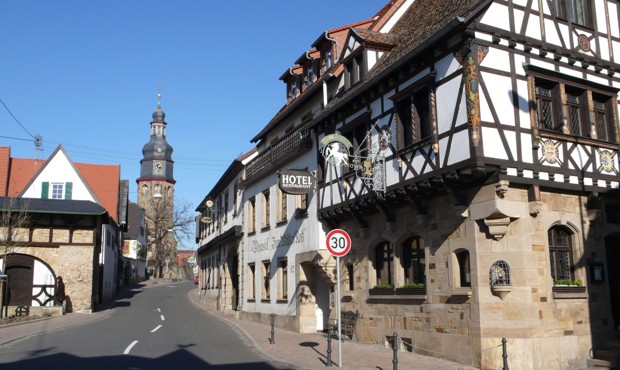
Donald Trump’s grandfather was from a little town in Germany called Kallstadt (from which, coincidentally, the Heinz family of ketchup fame also hailed). His sister had already made the trip to the U.S. and was living on the Lower East Side of New York, a center of the German community in Manhattan. Within about five years, he set off for the West Coast, where he made good money in the saloon and hotel business, according to Gwenda Blair, author of Donald Trump: Master Apprentice and The Trumps: Three Generations That Built an Empire.


Main Street in Kallstadt, Germany, circa 2008. (Prekario / Wiki Commons)
Blair says Friedrich Trump changed his name to Frederick when he applied for naturalization papers in Seattle in 1892 (a relatively easy process at the time). Frederick Trump ended up going back to Kallstadt to find a bride and married Elizabeth Christ, the proverbial girl next door. They returned to the U.S., but she was intensely homesick, and before long the couple went back to Germany and tried to resettle there.

The German authorities took issue, however, with Frederick Trump’s failure to enlist in the military, as required of young German men, and rejected his argument that he had been elsewhere during the customary period of service. Soon he and Elizabeth were on a boat back to America. “It was mere chance,” Blair tells CityLab, “that the Trumps ended up being American at all.”

Blair says she has no record of whether the family ever suffered any discrimination in the U.S. over their nationality. “There’s no indication that being German was a particular handicap in any way,” she says. But in the period leading up to World War I, American nativism was thriving once again, and German-Americans were seen as potentially traitorous if they failed to relinquish ties with their ancestral homeland.

By 1918, anti-German propaganda was everywhere. U.S. politicians were calling (unsuccessfully) for German place names across the country to be changed. Sauerkraut manufacturers pondered changing their product’s name to “liberty cabbage” (in a foreshadowing of the Iraq war’s “freedom fries”). German language studies were banned in schools. After Robert Prager, an unnaturalized German immigrant in Collinsville, Illinois, was lynched by a mob on suspicion of being a spy, the defendants pleaded “patriotic murder“ and were acquitted. 

No country for “hyphenated Americans”

In 1915, after the Great War had started in Europe but before the U.S. had entered, New York-born former president Teddy Roosevelt made a famous speech in which he cautioned against anything but complete abandonment of national identity for immigrants:
There is no room in this country for hyphenated Americans. When I refer to hyphenated Americans I do not refer to naturalized Americans. Some of the very best Americans I have even known were naturalized Americans born abroad. But a hyphenated American is not an American at all. The one absolutely certain way of bringing this nation to ruin, of preventing the possibility of it continuing to be a nation at all, would be to permit it to become a tangle of squabbling nationalities, an intricate knot of German-Americans, Irish-Americans, French-Americans, Scandinavian-Americans, or Italian-Americans, each preserving its separate nationality, each at heart feeling more sympathy with Europeans of that nationality than with the other citizens of the American Republic.
Roosevelt refined and enhanced this argument up until his death in 1919. His words on American identity are popular among right-wing Republican groups, and echo in the Republican presidential campaign today. In June, Louisiana governor and GOP presidential candidate Bobby Jindal scorned the concept of “hyphenated Americans” himself, releasing an ad in which he implicitly condemned the most recent waves of immigrants to the U.S.:
“The folks who want to immigrate to America, they should do so legally, they should adopt our values, they should learn English and they should roll up their sleeves and get to work.”
In this regard, the Trumps were model Americans of the unhyphenated variety. Donald’s grandfather Frederick died in 1918, probably as a result of that year’s flu pandemic. His namesake, Frederick C. Trump—known as Fred, and destined to become Donald’s father—was only 13. By age 15, according to a New York Times obituary, Fred had started his own construction company (with some help from his mother, who signed the papers her minor son could not). Thus began the Trump real estate empire, which Donald inherited and built into the juggernaut it is today.

The Trumps were the very picture of assimilated immigrant success—to the extent, says Blair, that when she visited Kallstadt to meet with the clan’s living members there, “they were a little ticked off,” in a good-humored way, that billionaire Donald didn’t acknowledge his German origins more often. In this sense he followed in his father’s footsteps. As Fred Trump built his fortune constructing housing for middle-class New Yorkers, he quietly let those around him believe he was of Swedish origin, a claim Donald repeated in his 1987 blockbuster, The Art of the Deal.
The New York Times obit for Fred Trump explained the obfuscation this way:
From World War II until the 1980's, Mr. Trump would tell friends and acquaintances that he was of Swedish origin, although both his parents were born in Germany. John Walter, his nephew and the family historian, explained, ''He had a lot of Jewish tenants and it wasn't a good thing to be German in those days.''
Swedish nationality continues to represent some Platonic ideal of blameless European identity to Donald Trump (who has since acknowledged his German roots). As The Washington Post recently noted, Trump frequently invokes Swedes as a sort of the ultimate non-Muslims. Look what he told CNN’s Jake Tapper: "I mean, it wasn't people from Sweden who blew up the World Trade Center, Jake."

Playing to a “fear of immigrants”

This may be the root of the Trump political genius, the way his personal subconscious anxieties and the subconscious anxieties of a nation seem so perfectly in accord. With his talk of Mexican rapists, his Obama birtherism, his sneering anti-Muslim remarks, his stated plan to build a wall along the border, Trump has succeeded in forcing those anxieties to center stage.

He has also effectively neutralized any idea that, as a citizen of the nation’s traditional center of immigration, he might have any sympathy for immigrants or be any less “American” for being a New Yorker. It’s a trick that Rudy Giuliani tried during his own 2008 presidential bid, but less boldly and with less success.


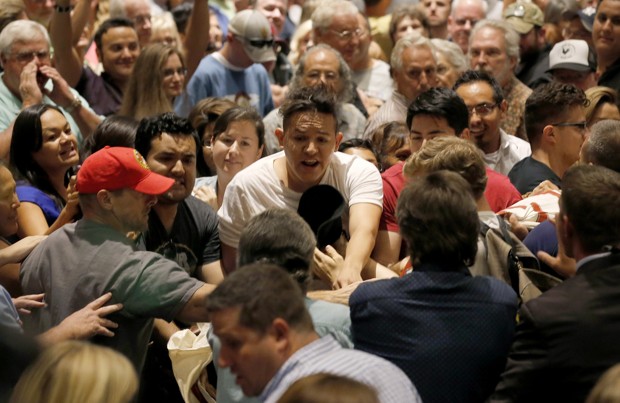
Donald Trump supporters clash with immigration rights protesters in Phoenix in July 2015. (AP Photo/Ross D. Franklin)
“If Donald Trump were running for mayor of New York, he wouldn’t be sounding like this, obviously,” says Nancy Foner, a professor of sociology at Hunter College who specializes in the comparative study of immigration. “He’s obviously playing to the right-wing base and to conservative whites who have a fear of immigrants changing America. It’s a fear among whites that they are no longer going to be dominant racially.”

Trump has succeeded in the polls by becoming the ultimate 21st-century nativist. Chasing him, even buttoned-down Republicans like Jeb Bush are scrambling to tap into the nation’s xenophobic tendencies. Just the other day, Bush spoke out against “creeping multiculturalism,” telling a young woman on the campaign trail in Iowa, “We should not have a multicultural society. When you create pockets of isolation, and in some cases, the assimilation process has been retarded, it’s wrong. It limits people’s aspirations.”

Foner says she is alarmed by the way Trump has changed the discourse about immigration over the course of the campaign. “It’s one thing to say these things on right-wing talk radio, it’s another thing to say them in a Republican debate on national television,” she says. “He goes beyond the bounds of acceptability of discourse in American public life, I would say. It’s successful, though.”

Norman Rockwell's Four Freedoms: "Maybe this country needs a bit of Fourth of July the year round."


todaysinspiration.blogspot.com (2011)

During WWII Norman Rockwell, being too old to enlist, decided that the best way he could contribute was to do posters for the government. To that end he devised the concepts for "The Four Freedoms," based on the Atlantic Charter proclamation issued by Roosevelt and Churchill.

But despite his best efforts, no government official in any department was interested. After many rejections Rockwell found himself making once last appeal; to the Office of War Information "or, to speak plainly," wrote Rockwell in his autobiography, "the propaganda department."

Rockwell24

"I showed the Four Freedoms to the man in charge of posters but he wasn't even interested. "The last war you illustrators did the posters," he said. "This war we're going to use fine arts men, real artists."

Finally, almost coincidentally, Rockwell showed the Four Freedoms to Saturday Evening Post editor Ben Hibbs, who immediately, enthusiastically commissioned their completion. "Drop everything else," said Hibbs, "just do the Four Freedoms. Don't bother with Post covers or illustrations."

Rockwell26

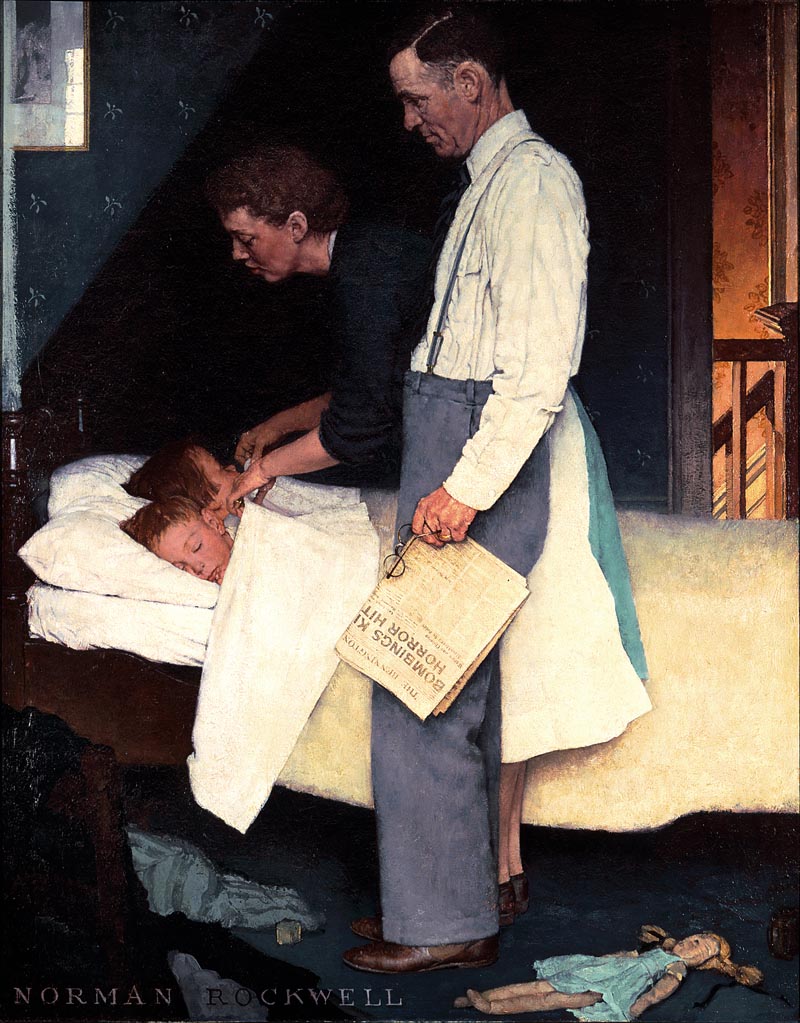
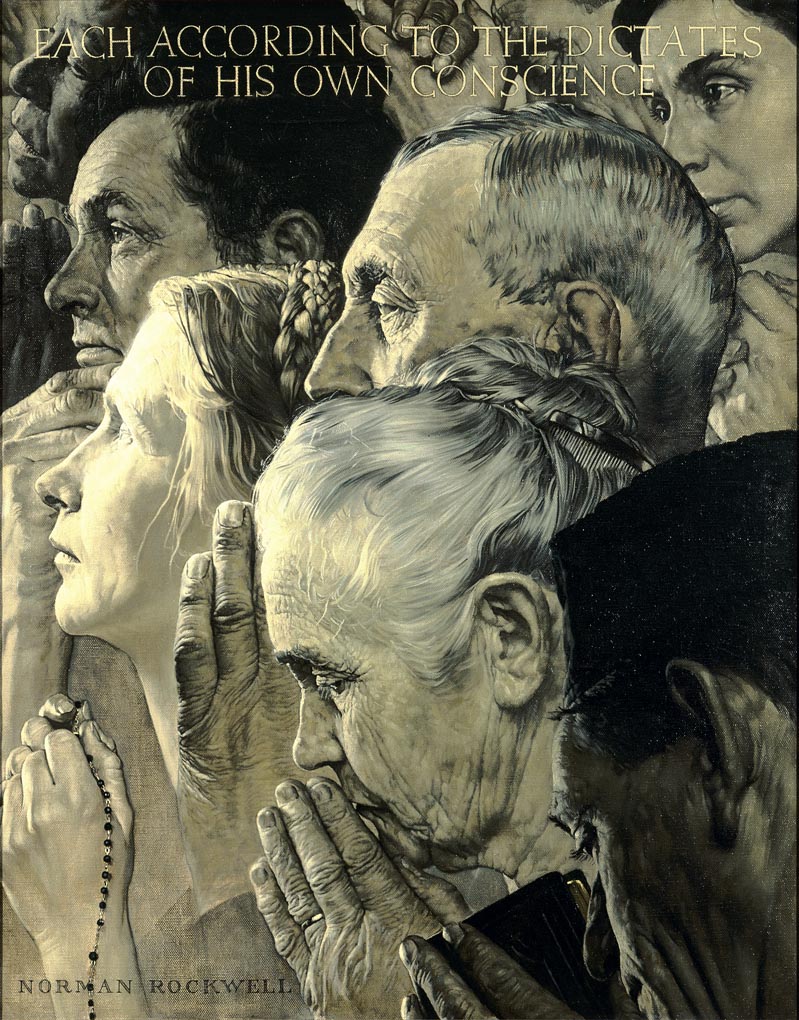
Rockwell spent six months on the four paintings. 'Freedom from Want' and 'Freedom from Fear' (both above) came quite easily... but he struggled tremendously with 'Freedom of Speech' and 'Freedom of Worship' (below), wanting to make his feelings on these subjects abundantly clearly to all those who would eventually see them. Rockwell painted and repainted these two pieces until he was satisfied he had "boiled it down into a clear, precise statement."

Rockwell29

When the Four Freedoms were done, "The results astonished us all." Wrote Saturday Evening Post editor Ben Hibbs. "Requests to reprint came in from other publications. Various Government agencies and private organizations made millions of reprints and distributed them all over the world."

"The Treasury Department took the originals on a tour of the nation... to sell war bonds. They were viewed by 1,222,000 people in 16 leading cities and were instrumental in selling $132,992,539 worth of bonds."

"'Freedom of Worship' and 'Freedom of Speech' hang in my own office, and I love them. They are a source of daily inspiration to me - in the same way that the clock tower of Old Independence hall, which I can see from my office window, inspires me. If this is Fourth of July talk, so be it. Maybe this country needs a bit of Fourth of July the year round."

Rockwell28

Hibbs continued, "Visitors... always exclaim over these paintings. They marvel at the depth of feeling which Norman was able to build into those pictures. Many people have asked me whether I regard the 'Freedom of Worship' and the 'Freedom of Speech' as great art. I do. Norman himself probably would disagree.

"He has always modelled himself an 'illustrator' with no pretensions of fine art."


* The Four Freedoms, as reproduced in today's post, appear courtesy of the Norman Rockwell Museum

Freedom from Want, Norman Rockwell. 1943. Oil on canvas, 45 ¾ x 35 ½" Story illustration for The Saturday Evening Post, March 6, 1943 ©1943 SEPS: Licensed by Curtis Publishing, Indianapolis, IN From the permanent collection of Norman Rockwell Museum

Freedom from Fear, Norman Rockwell. 1943. Oil on canvas Story illustration for The Saturday Evening Post, March 13, 1943 From the permanent collection of Norman Rockwell Museum ©1943 SEPS: Licensed by Curtis Publishing, Indianapolis, IN (S569)

Freedom of Speech, Norman Rockwell. 1943. Oil on canvas, 45 ¾” x 35 ½” From the permanent collection of Norman Rockwell Museum ©1943 SEPS: Licensed by Curtis Publishing, Indianapolis, IN Story illustration for The Saturday Evening Post, February 20, 1943

Freedom of Worship, Norman Rockwell. 1943. Oil on canvas, 46” x 35 ½” Story illustration for The Saturday Evening Post, February 27, 1943 ©1943 SEPS: Licensed by Curtis Publishing, Indianapolis, IN From the permanent collection of Norman Rockwell Museum

Tuesday, January 5, 2016

Even teaching about Beyoncé can’t save your job if you’re an adjunct professor


The perils of the academic job market

Washington Post


Kevin Allred is an adjunct lecturer on Women's and Gender Studies at Rutgers University.


In 2010, I began teaching a course at Rutgers called “Politicizing Beyoncé.” My students read a survey of black feminist activists across American history, alongside critical analysis of Beyoncé’s music.
The class quickly became one of the university’s most popular, filling to capacity each of the 11 times I’ve offered it since. I’ve been invited to teach mini-sessions on the subject everywhere from Claremont McKenna College to Harvard University. I’m currently adapting the curriculum into a book.
Then, the class was cancelled.
I wasn’t warned in advance — I found out only when I received my 2016 schedule. The University’s Women’s and Gender Studies department has refused to communicate with me about their decision.
Sadly, this is an all-too-common experience for adjunct lecturers, who make up 5o percent of college faculty nationwide. Rutgers’s 1,300 adjuncts teach 30 percent of all courses. Often, we’re saddled with low-level classes that tenured faculty prefer not to teach. Yet, only 0.6 percent of Rutgers’s operating budget is devoted to adjunct teaching. Unlike tenured faculty, adjuncts don’t receive a salary. Instead, they get a small lump sum for each course taught. Even teaching four courses a semester (considered full-time) results in poverty-level wages. And if an adjunct receives no courses for a semester, they receive no income. It’s a precarious position to be in on a good day.
This is even more complicated when an adjunct wants to offer a class that challenges the academic orthodoxy. And my Beyoncé class did just that. Though the singer has been featured in courses on the music industry and economics, just a handful of professors situate her as a black feminist figure in line with Sojourner Truth, Ida B. Wells and more contemporary black feminist activists. These courses are hugely popular at their respective schools. Even so, my colleagues and professors at other schools attacked the course as unserious. 
Obviously, popularity or pop associations shouldn’t be the arbiters of what gets offered in university classrooms. But why shouldn’t students themselves have a say in what comprises their own education? Can’t education be fun as well as informative? My Beyoncé class resonates deeply and powerfully with my students. This isn’t often the case. University faculty are often more invested in their own egos than teaching, or finding new and creative ways to reach students. Sadly, this often persists regardless of the identity of those who hold the power in any given academic department. Often, scholars in departments assumed to be politically progressive are those most tied to traditional power dynamics so as not to rock the boat. Those that theorize power’s demise in the abstract are often the same ones clinging most directly to their own sense of power and elitism in academia. And just like in society, in academic departments, the powerful few make decisions for the powerless many — regardless of what students themselves desire.
Audre Lorde famously stated, “The master’s tools will never dismantle the master’s house.” At first glance, Beyoncé might seem to many like the definition of the master’s tools. She works from within capitalism; she’s selling a brand, selling records. But at the same time, she’s something different. Her challenge to power unsettles. Her surprise 2013 visual album release — a giant middle finger to the traditional rules of the music industry — is evidence that she has tools that, at the very least, pose a threat to the master’s house.
When students see the explicit challenge to the status quo that Beyoncé enacts, though, they get inspired, empowered. Beyoncé might be selling a brand, but she’s also selling students hope that the “things people pretend they’re too smart to like” deeply matter, to paraphrase TV-host and activist (and author on the “Politicizing Beyoncé” syllabus) Janet Mock. And when you take seriously the things that matter to students, students themselves believe that they matter.
My story has a happy ending. I found a new home for the class in the American Studies department, where it fits in beautifully with other courses they offer on Bruce Springsteen, hip hop and U.S. pop culture. Look to American Studies at Rutgers for Fall 2016. “Politicizing Beyoncé” will be there.

The God Profusion - Note for a lecture, "E Pluribus Unum? What Keeps the United States United"


wsj.com

Europe’s churches are empty—but don’t take that as a sign of reason’s triumph. More than half of Icelanders believe in elves and trolls.

God is not dead. Despite the predictions of academics and liberal religious leaders, the world is becoming more faith-filled, not less. According to Rodney Stark, the co-director of the Institute for Studies of Religion at Baylor University, there has been no rise of the “nones”—no increase in the number of the world’s self-professed atheists and no triumph of reason over revelation.
One of Mr. Stark’s targets in “The Triumph of Faith” is certain modern polling firms, including the Pew Survey, that routinely announce a significant increase in the number of Americans claiming no religious affiliation. As Alan Cooperman, Pew’s director of religion, reported last year: “The country is becoming less religious as a whole.” Mr. Stark criticizes the methods of Pew and other firms by asserting that their response rates are too small to justify the broad claims they make.
His real battle, though, is with intellectual elites of the West, who have been declaring the demise of religion for centuries and have been advancing a secularization thesis for decades. For them, religious belief is a susceptibility of the illiterate and ignorant. With education, in their view, people see the foolishness of their ways and abandon their beliefs. Education is spreading ever further, thanks to affluence and technology: Hence the slow decline of faith.
ENLARGE

THE TRIUMPH OF FAITH

By Rodney Stark
ISI, 258 pages, $24.95
Mr. Stark pushes back against the secularization thesis in several ways. In a section called “The Myth of Medieval Piety,” he notes, for example, that during the so-called Dark Ages of Europe—when religion supposedly stifled the life of the mind and benighted the populace—more than 90% of the population lived in rural areas, while churches were to be found mostly in towns and cities: “Therefore hardly anyone could have attended church. Moreover, even after most Europeans had access to a church, whether Catholic or Protestant, most people still didn’t attend, and when forced to do so, they often misbehaved.”
In short, the poor and less educated are not by definition more pious. As for the other half of the secularization thesis, Mr. Stark shows that, in one country after another today, more educated people are choosing religion in larger numbers than their less educated peers. This is certainly true in the United States, where college-educated Americans are more likely to attend religious services than their counterparts with only a high-school diploma. 
Indeed, religious fervor has taken hold in many countries where modernity is a settled fact. In majority-Muslim countries the percentage of people attending mosque is highest among those with a college education. Mr. Stark writes that the people in these countries who are most offended by Western culture tend not to be village hicks but people living in modernized, urban areas.
Scholars like Philip Jenkins have for years observed that in the Southern Hemisphere religious belief—particularly Christianity and Islam—has been spreading rapidly. Here Mr. Stark cites a poll that he trusts: the Gallup World Poll, which has been conducted annually since 2005 and now includes more than a million interviews from 163 different countries. According to Gallup, almost all South American countries are now less than 5% secular. While Catholicism used to be the dominant form of Christianity, because it was the official religion of the colonizing powers, Protestantism “has become a major religious presence in most of Latin America.” 
Mr. Stark argues that, in general, the government sponsorship of religion is a hindrance to the growth of a faith. Monopoly destroys competition, and competition, he says, causes growth—in religious affiliation as much as in the marketplace for goods and services. In many places around the globe, the competition among Muslims, evangelicals, Catholics, Mormons, Jehovah’s Witnesses and hundreds of smaller religious groups has resulted in an atmosphere of revival. A smug complacency has been replaced by a fervor to win souls.
Not in Europe, however, where the churches, once so important, are now empty. For the champions of the secularization thesis, such a development is nothing to complain about: Empty churches are a sign of reason’s progress. Mr. Stark offers some amusing evidence to the contrary. Drawing on the Gallup poll, he notes that Europeans hold all sorts of supernatural beliefs. In Austria, 28% of respondents say they believe in fortune tellers; 32% believe in astrology; and 33% believe in lucky charms. “More than 20 percent of Swedes believe in reincarnation,” Mr. Stark writes; “half believe in mental telepathy.” More than half of Icelanders believe in huldufolk, hidden people like elves and trolls. It seems as if the former colonial outposts for European missionaries are now becoming more religious, while Europe itself is becoming interested in primitive folk beliefs.
Mr. Stark may criticize the methods of Pew and other polling firms, but there is no doubt that fewer Americans than ever before claim an association with a particular sect or denomination. They may be religious by some definition, but they are “unchurched.” The folks at Pew are not atheist triumphalists. They do seem to be tracking what Mr. Stark acknowledges to be the “social consequences” of the changes in the way people identify.
And while it is true that the most educated members of American society are the ones going to church, their attendance and affiliation is likely to decline in the coming years, in part because of changes in family dynamics. Americans are getting married at later ages or increasingly not at all. And it has traditionally been marriage that brings young adults back to religion or keeps them in the fold. Such changes may be a blip on the global screen, though. God only knows.
Ms. Riley is the author of “Got Religion?: How Churches, Mosques, and Synagogues Can Bring Young People Back” and “ ’Til Faith Do Us Part: How Interfaith Marriage is Transforming America.”

Health Care in U.S.


The New York Times - The New York Times 1/5/2016

A detailed study out today shows that about 20 percent of Americans under the age of 65 and with health insurance say they have problems paying their medical bills.
The data reflects the high costs of health care in the U.S., the most expensive place in the world for medical services. Even under the Affordable Care Act, health plans often require hundreds or thousands of dollars in out-of-pocket payments.

See more detail at NYTimes.